AI Search: How AI Overviews Change SEO
Learn how Google's AI Overviews are changing SEO and how to adapt your strategy. Data-driven insights on traffic impact, optimization tactics, and measuring visibility.

Adapting to AI Search: How Google's AI Overviews Change SEO
Introduction
This isn't speculation or future-gazing. AI Overviews are live, appearing on millions of queries daily, and fundamentally changing how users interact with search results. For SEO practitioners, content strategists, digital marketers, and business owners, the question is no longer "Will AI search affect me?" but rather "How do I measure my exposure and adapt my strategy?" This comprehensive guide covers everything about AI-powered search and how to optimize for it:
- The evolution of search from traditional blue links to AI-powered conversations
- How Google AI Overviews work and when they appear
- Real traffic impact data across industries and query types
- Optimization strategies that increase your chances of being cited
- Measurement methodology using Google Search Console
- Future-proofing tactics for long-term success Whether you're seeing traffic declines, trying to understand your exposure, or preparing for the future, this guide provides the data-driven insights and actionable strategies you need to succeed in the AI search era.
The Evolution of Search: From Blue Links to AI Conversations
The search experience we've known for two decades is being rebuilt from the ground up. Understanding how we got here—and where we're headed—is essential for adapting your SEO strategy.
Traditional Search vs AI-Powered Search
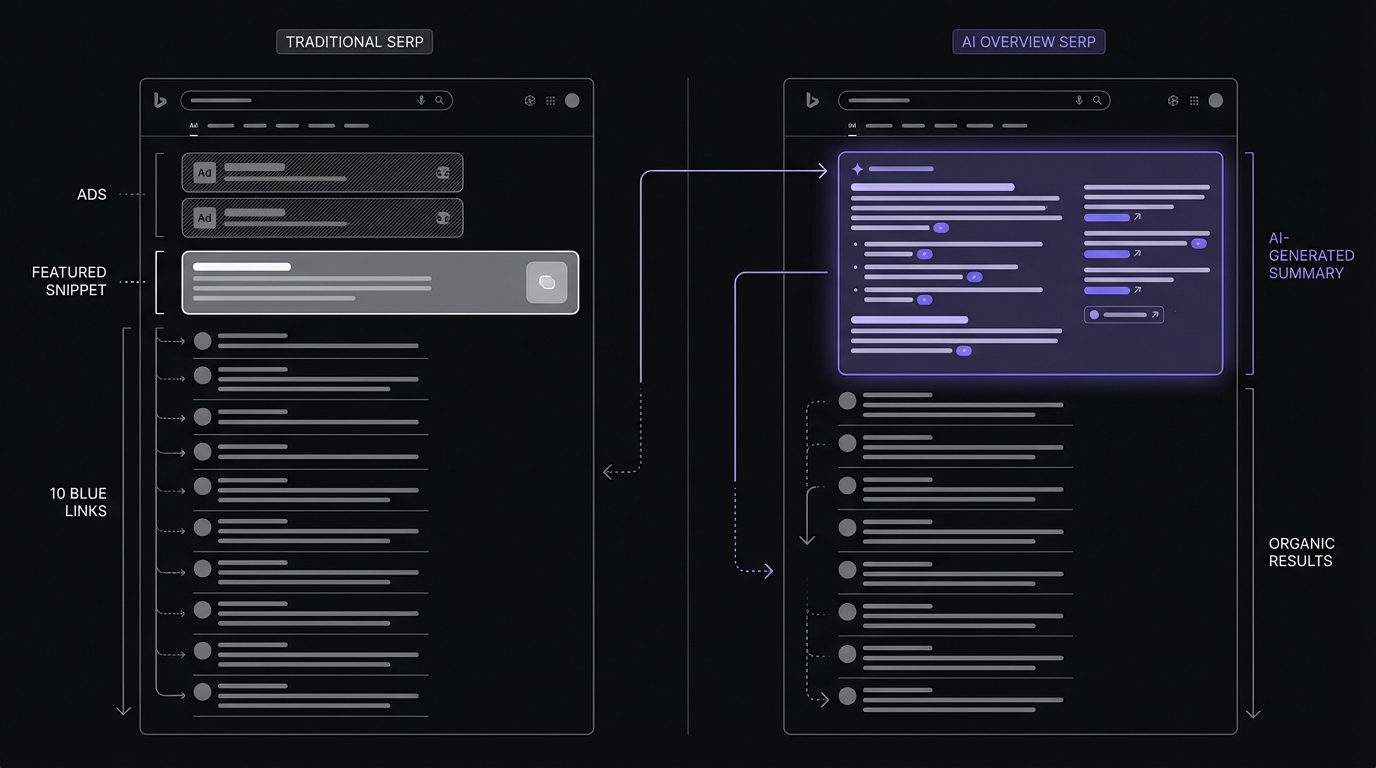
Traditional SERP Anatomy: For years, search results followed a predictable pattern:
- Ads at the top (typically 2-4)
- Featured snippets (when triggered)
- People Also Ask boxes
- 10 organic results ("blue links")
- Related searches at the bottom User behavior was equally predictable: users scanned the page, clicked one or more results, read content on those sites, and potentially returned to the SERP to try another result. The entire experience centered around getting users to leave Google and visit websites. AI Overview SERP Anatomy: Today's AI-powered search results look dramatically different:
- AI Overview at the top
- Source attributions
- Traditional ads (pushed down)
- Remaining organic results
- Traditional SERP features (further down)
 Key Differences in User Behavior:
The behavioral shift is profound:
Key Differences in User Behavior:
The behavioral shift is profound: - Information gathering without clicking: Users often get their answer directly from the AI Overview without clicking any sources
- Source validation: When users do click, they're validating or seeking depth on information already provided
- Reduced page 2+ exploration: If the AI Overview doesn't answer the query, users reformulate rather than clicking through multiple results
- Increased trust in AI-generated answers: Early data shows 60%+ of users trust AI Overview information without verification This fundamental shift explains why many site owners are seeing traffic declines despite maintaining their rankings. For detailed analysis of AI Overview traffic impact, see our comprehensive study: AI Overviews Impact on Traffic - What the Data Shows.
Timeline of AI Search Development
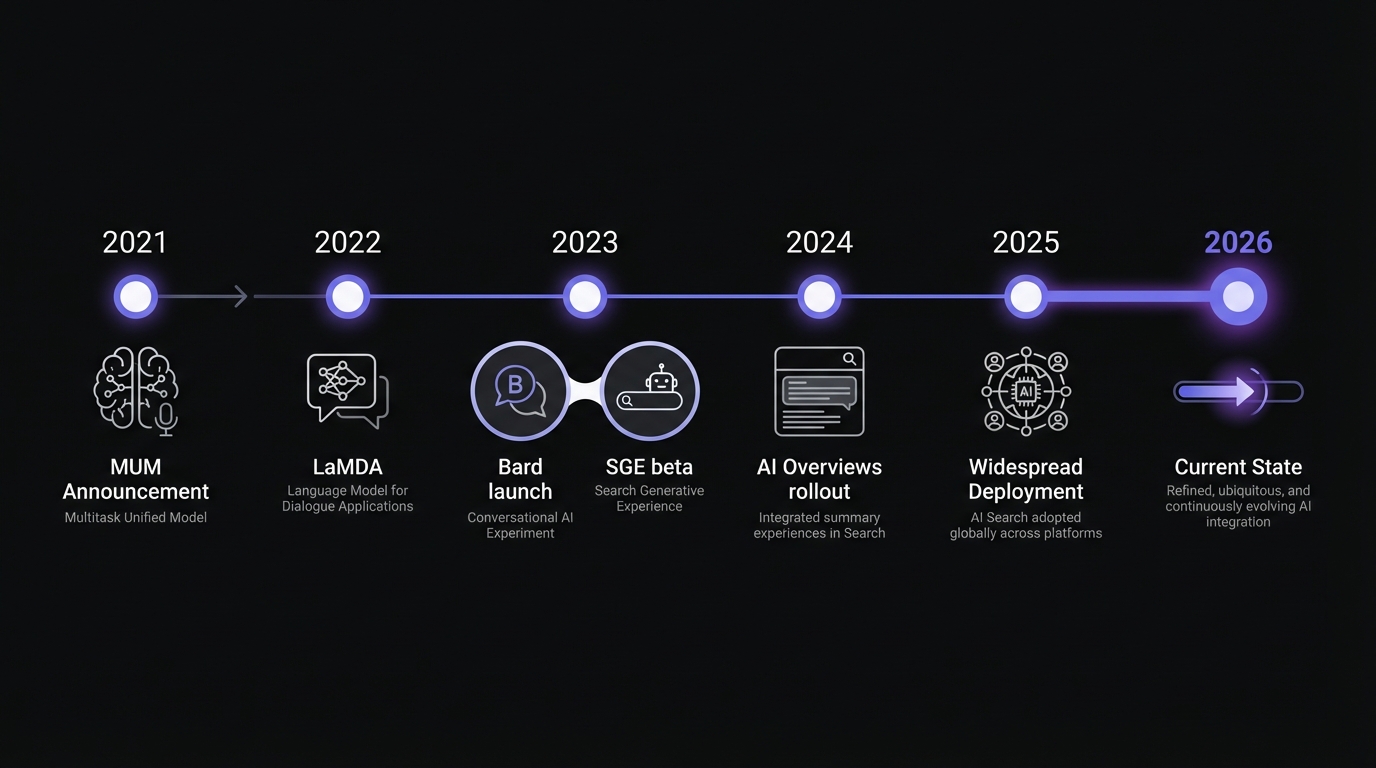
Understanding Google's journey to AI Overviews helps contextualize the current state and predict future developments. 2021: MUM (Multitask Unified Model) Announcement
- Google announced MUM, a model 1,000x more powerful than BERT
- Promised to understand complex, multi-faceted queries
- Laid groundwork for AI-powered search experiences 2022: LaMDA and Early Experimentation
- LaMDA development
- Internal testing of conversational search experiences
- Foundation for what would become Bard and SGE 2023: The Year of Transformation
- February 2023: Google announces Bard in response to ChatGPT's success
- May 2023: Google I/O unveils Search Generative Experience (SGE) in beta
- Q3-Q4 2023: Limited rollout to Search Labs participants
- Intense competition with Microsoft's Bing Chat and OpenAI's ChatGPT 2024: AI Overviews Rollout
- Q1 2024: SGE renamed to "AI Overviews" as Google prepares for wider launch
- May 2024: Google I/O announces broad AI Overviews rollout
- Q2 2024: Phased deployment begins (US mobile first)
- Q3-Q4 2024: Expansion to desktop and additional countries
- SEO community reports significant traffic changes 2025: Widespread Deployment and Refinement
- Q1 2025: AI Overviews available for majority of informational queries
- Google refines algorithms for source selection and quality
- Integration with other Google services (Maps, Shopping)
- Introduction of follow-up questions and conversational features 2026: Current State and What's Next
- AI Overviews now standard feature across most markets
- Continuous improvement in accuracy and relevance
- Expansion to more query types (commercial, local)
- Industry adaptation and new SEO best practices emerging
Major Players in AI Search
Google dominates search market share but the AI search landscape includes multiple players, each with different approaches and opportunities. Google AI Overviews (formerly SGE)
- Market Position: Dominant with 90%+ search market share in most countries
- Technology: Powered by Gemini (Google's latest LLM)
- Approach: AI-generated summaries with source attribution
- Monetization: Integrating ads within and around AI Overviews
- SEO Opportunity: Critical to optimize for due to reach ChatGPT with Browsing/Search
- Market Position: Growing rapidly, 180M+ weekly active users (late 2025)
- Technology: GPT-4 and newer models with real-time web access
- Approach: Conversational interface with cited sources
- Monetization: Subscription model (ChatGPT Plus)
- SEO Opportunity: Increasing as search feature improves Perplexity AI
- Market Position: Niche but growing, 50M+ monthly users
- Technology: Multiple LLMs with web search integration
- Approach: Academic-style citations, source-first philosophy
- Monetization: Freemium model with Pro tier
- SEO Opportunity: Valuable for specific verticals (research, technical) Bing Copilot (formerly Bing Chat)
- Market Position: 3-4% search market share, but integrated across Microsoft products
- Technology: Partnership with OpenAI, GPT-4 based
- Approach: Conversational search with source cards
- Monetization: Microsoft 365 integration, enterprise focus
- SEO Opportunity: Worth monitoring, especially for enterprise B2B Market Share and Usage Data: As of Q4 2025:
- Google Search: ~91% global market share, AI Overviews on 40-60% of queries
- ChatGPT: Not traditional search, but 15%+ of users report using it as search replacement
- Bing: ~3% market share, but Copilot integration expanding reach
- Perplexity: <1% market share, but growing 30% month-over-month
- Other: <5% combined
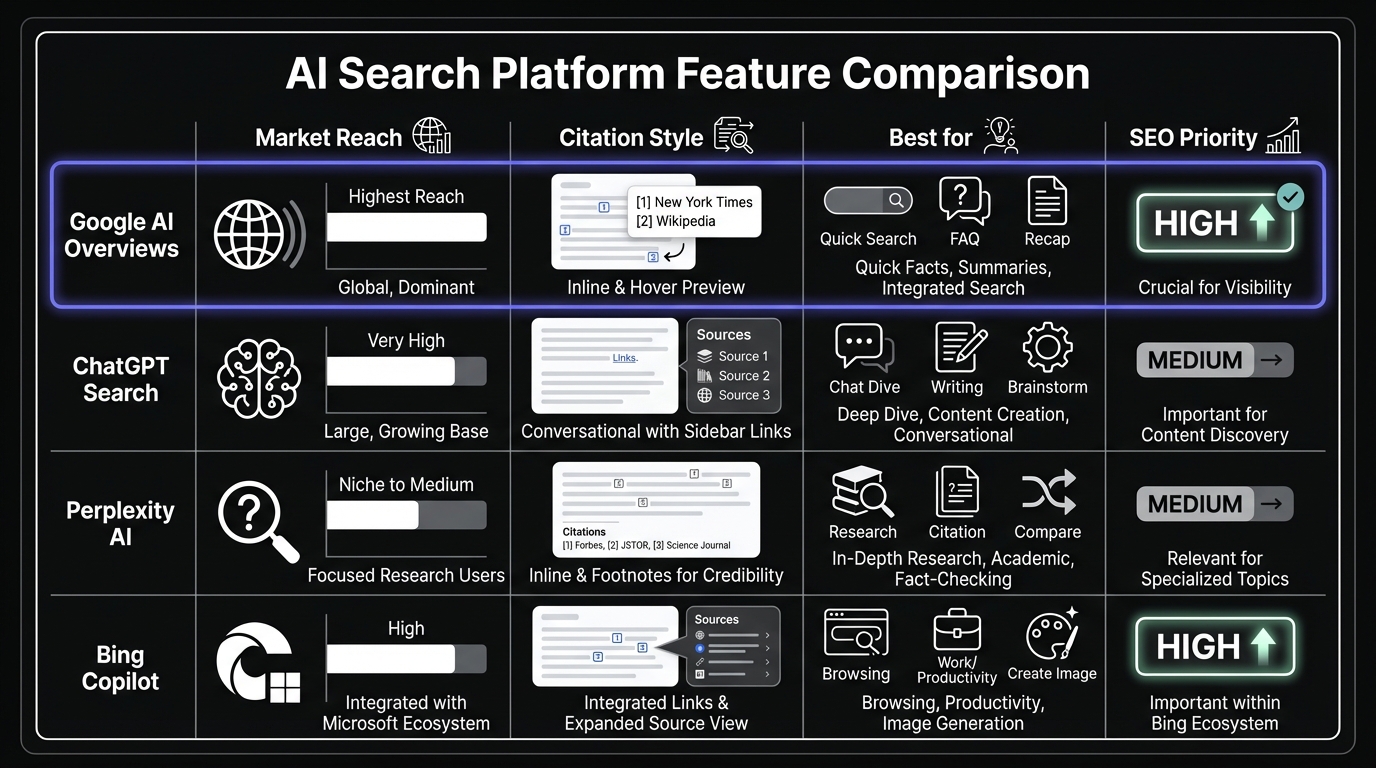 Strategic Implication: Google remains the priority for most businesses but diversification across AI search platforms may become increasingly important, especially as younger users adopt alternative search tools.
How Google AI Overviews Work
Understanding the technology and logic behind AI Overviews is essential for optimizing your content to be selected as a source.
The Technology Behind AI Overviews
Large Language Models (Gemini) AI Overviews are powered by Google's Gemini family of models, specifically optimized for search tasks:
- Gemini Pro: Handles most search queries, balancing speed and quality
- Gemini Ultra: Used for complex, multi-faceted queries requiring deeper analysis
- Specialized fine-tuning: Models trained specifically on search relevance signals Unlike standalone LLMs like ChatGPT, Google's AI Overviews leverage:
- Real-time index integration: Access to Google's constantly updated search index
- Query understanding: Decades of query classification and intent detection
- Personalization signals: User history, location, and context (when relevant) Real-Time Web Indexing Integration This is Google's key advantage over competitors:
- AI Overviews pull from Google's search index, not a static training dataset
- Content can appear in AI Overviews within hours of being indexed
- Allows for timely, up-to-date information in AI-generated answers
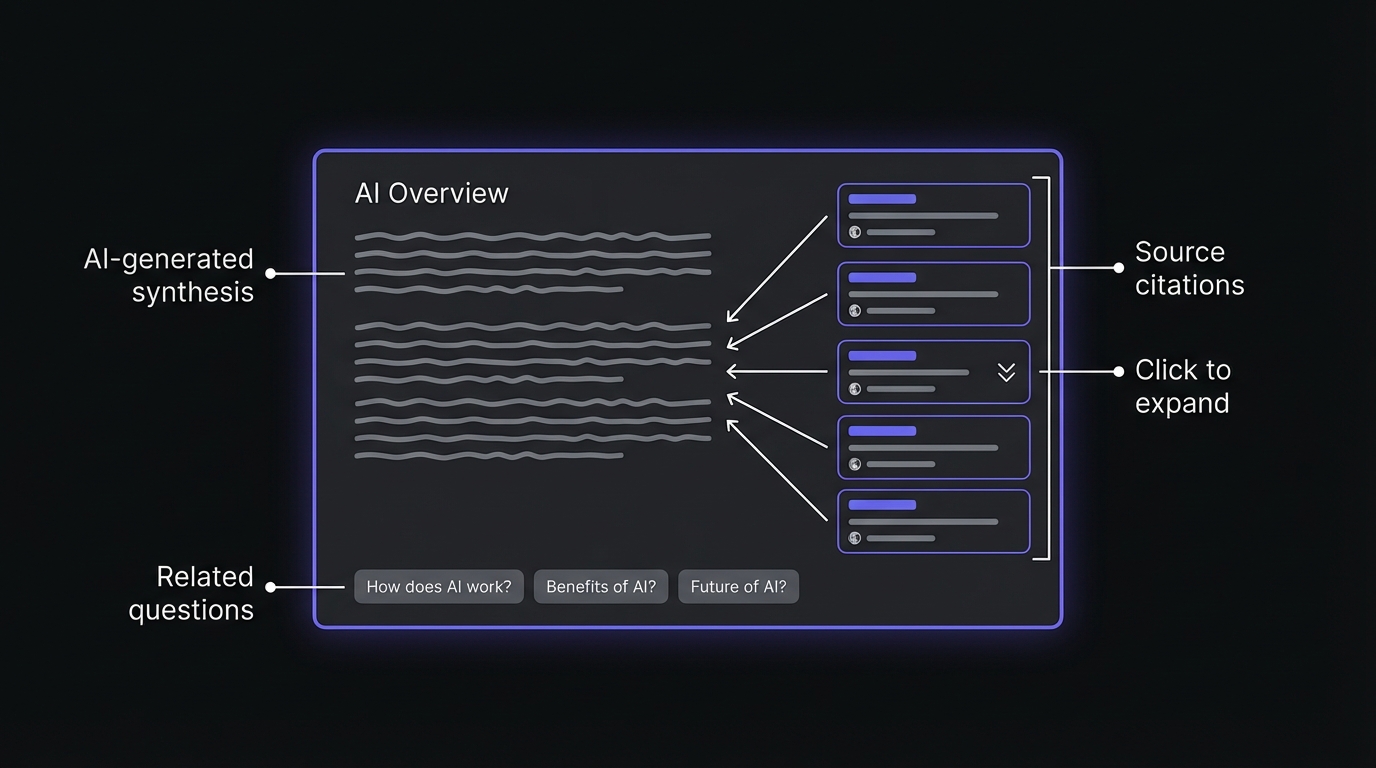
- Combines structured data (Knowledge Graph) with unstructured web content Source Attribution System Every AI Overview includes citations to source websites:
- Typically 3-8 sources are cited per AI Overview
- Sources appear as clickable links within the generated text
- Source selection based on relevance, authority, and comprehensiveness
- Multiple sources often synthesized into single cohesive answer Fact-Checking and Reliability Mechanisms Given the risks of AI hallucination and misinformation, Google implements multiple safety layers:
- Multi-source verification: Claims typically verified across multiple high-authority sources
- YMYL safeguards: Extra scrutiny for health, finance, legal topics
- User feedback loops: "This looks wrong" reporting helps refine algorithms
- Manual review: Human evaluators assess AI Overview quality for sensitive topics
- Conservative triggering: AI Overviews less likely to appear for controversial or unclear queries
When AI Overviews Appear
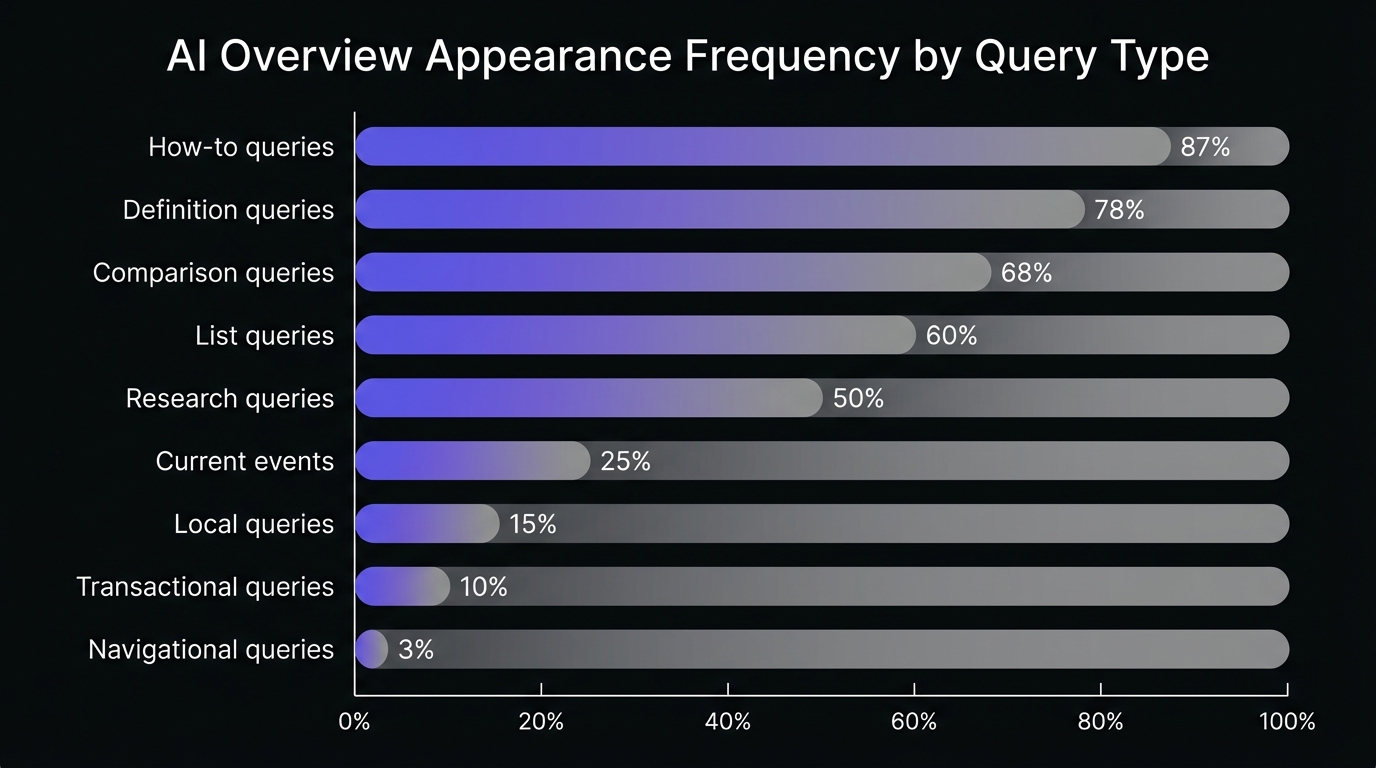
Not all queries trigger AI Overviews. Understanding the patterns assess your exposure and risk. Query Types Most Likely to Trigger AI Overviews:
- Informational "How-To" Queries (80-90% trigger rate)
- "How to change a tire"
- "How to bake sourdough bread"
- "How to fix a leaky faucet"
- Definition and Explanation Queries (70-85% trigger rate)
- "What is SEO"
- "What causes inflation"
- "Why do cats purr"
- Comparison Queries (60-75% trigger rate)
- "iPhone 15 vs Samsung S24"
- "React vs Vue comparison"
- "Best CRM for small business"
- List-Based Information Queries (50-70% trigger rate)
- "Best restaurants in Austin"
- "Top 10 project management tools"
- "Symptoms of strep throat"
- Research and Analysis Queries (40-60% trigger rate)
- "Climate change effects on agriculture"
- "Benefits of intermittent fasting"
- "How AI affects job market" Query Types Less Likely to Trigger AI Overviews:
- Transactional Queries (5-15% trigger rate)
- "Buy iPhone 15"
- "Nike shoes sale"
- Product-specific purchase intent
- Navigational Queries (0-5% trigger rate)
- "Facebook login"
- "YouTube"
- Brand name searches
- Local Queries (10-20% trigger rate)
- "Pizza near me"
- "Dentist Austin Texas"
- Local pack results remain dominant
- Current Events/Breaking News (20-30% trigger rate)
- Recent events, sports scores, stock prices
- Google News and Top Stories remain primary features
- Personal/Subjective Queries (15-25% trigger rate)
- "Best movie ever"
- "Prettiest beach in California"
- Highly subjective topics with no clear consensus
 Industry Verticals Most Affected:
Research shows AI Overview appearance varies significantly by industry:
Industry Verticals Most Affected:
Research shows AI Overview appearance varies significantly by industry: - Recipes and Cooking: 75-85% of queries
- Health and Medical: 65-80% of queries
- How-To and DIY: 70-80% of queries
- Technology and Software: 55-70% of queries
- Education and Learning: 60-75% of queries
- E-commerce and Products: 20-35% of queries
- Local Services: 10-20% of queries
- Entertainment: 40-55% of queries Mobile vs Desktop Differences: AI Overviews rolled out mobile-first, and differences persist:
- Mobile: Higher AI Overview appearance rate
- Desktop: Slightly lower rate
- Reason: Mobile users prefer quick answers without clicking
- Trend: Desktop catching up as feature matures
How Sources Are Selected
This is the critical question for SEO practitioners: How does Google choose which websites to cite in AI Overviews? E-E-A-T Signals Importance Google's established E-E-A-T framework (Experience, Expertise, Authoritativeness, Trust) is even more critical for AI Overview source selection:
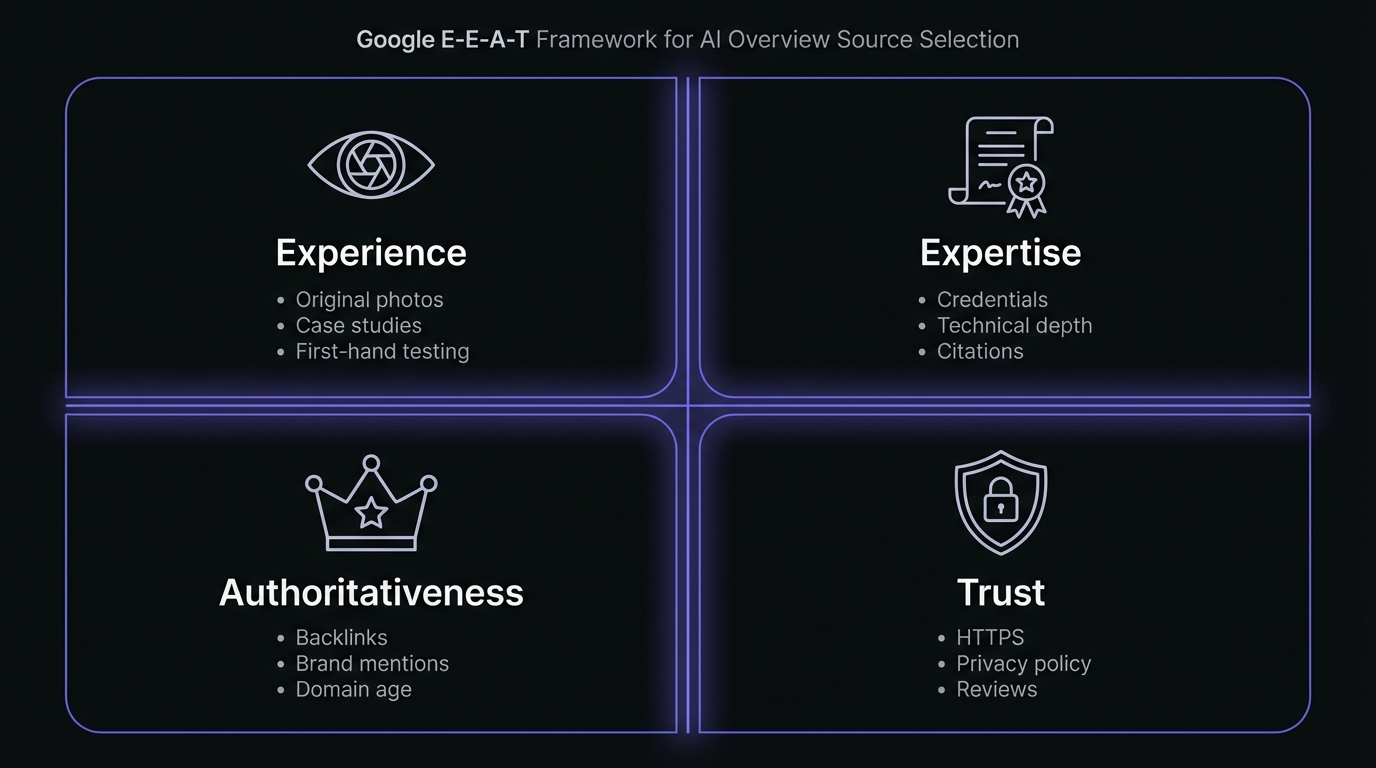 Experience: First-hand expertise demonstration
- Original photos, videos, or demonstrations
- Case studies from personal application
- Real-world testing and results
- "I tried this" vs "Sources say this" Expertise: Credentials and subject matter knowledge
- Author credentials and qualifications
- Industry recognition and awards
- Citations of work by others
- Technical depth and accuracy Authoritativeness: Domain and content authority signals
- Backlink profile quality and quantity
- Brand mentions across the web
- Citations in other authoritative sources
- Domain age and consistency Trust: Reliability and security signals
- HTTPS and security certificates
- Transparent ownership and contact info
- Privacy policy and terms
- Positive user reviews and reputation
- Absence of deceptive practices Content Depth and Comprehensiveness AI Overviews favor sources that:
- Thoroughly cover the topic: Comprehensive guides outperform shallow content
- Answer related questions: Content that anticipates follow-up questions
- Provide context: Background information and related concepts
- Include examples: Concrete examples and case studies
- Cite their own sources: Well-researched content with references Structured Data Influence not the only factor but structured data helps:
- FAQPage schema: Questions and answers format aligns with AI Overview structure
- HowTo schema: Step-by-step instructions in structured format
- Article schema: Helps Google understand content type and topic
- Organization schema: Builds entity recognition and authority
- Review schema: Provides credibility signals for product/service content Domain Authority Factors Traditional SEO authority signals still matter:
- Backlink profile: Quality and relevance of inbound links
- Brand strength: Direct searches, branded mentions
- Historical performance: Track record of accurate, helpful content
- Niche authority: Specialization in specific topic areas
- User engagement signals: Click-through rates, time on page, return visits Real Example: Dissecting a GSC Query that Triggered AI Overview a real query: "how to optimize images for web" AI Overview Source Analysis:
- Source 1: Major web development blog
- Source 2: Image optimization tool documentation
- Source 3: Google's own web.dev documentation
- Source 4: Developer community site Why These Sources Were Selected:
- All had published comprehensive (2,000+ word) guides on the topic
- Each demonstrated technical expertise with code examples
- Sources had strong backlink profiles and domain authority
- Content included images, step-by-step instructions, and best practices
- Proper use of structured data Notably Missing:
- Thin content sites with brief definitions
- Sites without HTTPS or clear authorship
- Content farms and low-quality directories
- Sites with poor user experience or slow loading
AI Overview User Experience
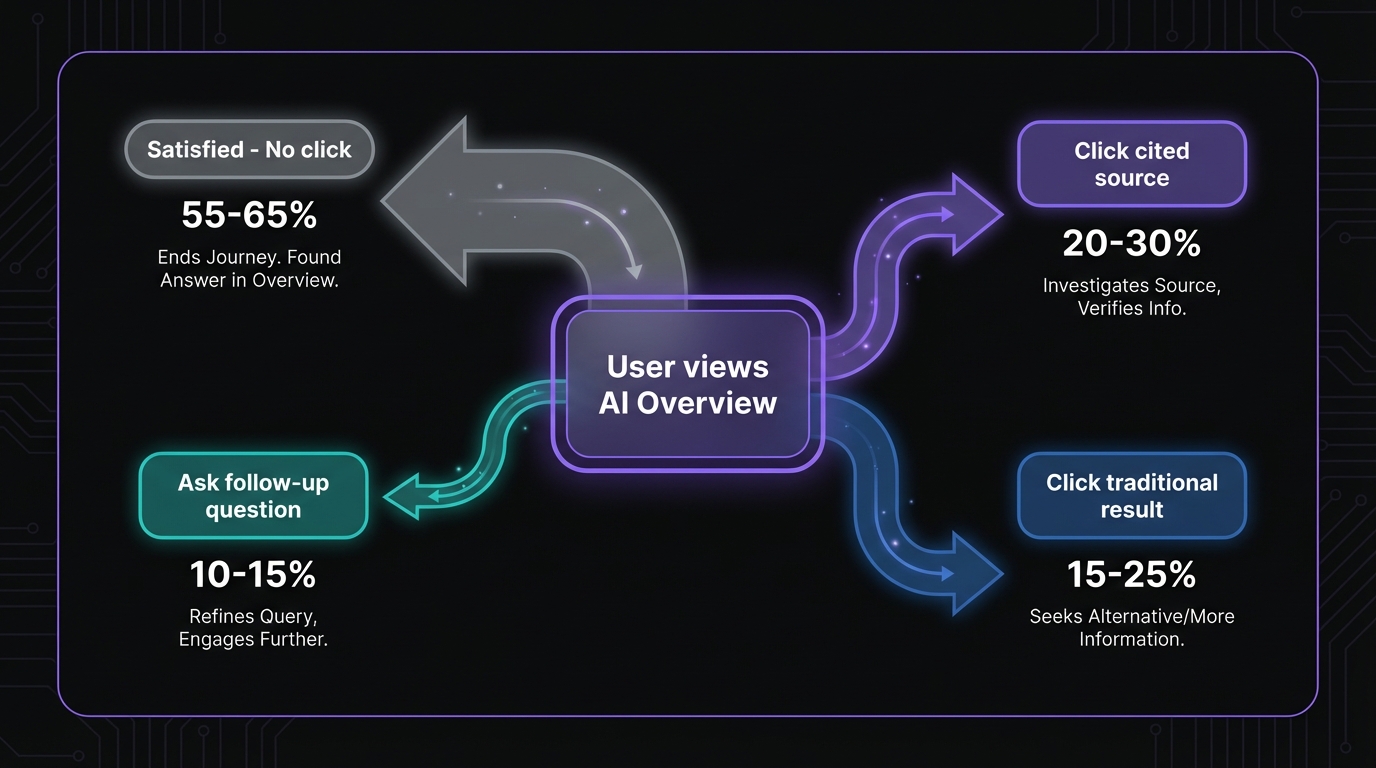
Understanding how users interact with AI Overviews informs optimization strategy. Click-Through Behavior Research Early studies (Q4 2025) show:
- Zero-click rate: 55-65% of queries with AI Overviews result in no click
- Source click-through: 20-30% of users click at least one cited source
- Traditional results: 15-25% of users bypass AI Overview and click traditional results
- Follow-up queries: 10-15% reformulate query or ask follow-up Time Spent on SERP vs Clicking Through Eye-tracking and engagement studies reveal:
- Average time reading AI Overview: 15-45 seconds
- Decision point: Most users decide whether to click within 30 seconds
- Information sufficiency: If AI Overview fully answers query, click-through drops to 10%
- Verification behavior: Users who do click often seeking to verify or go deeper Follow-Up Query Patterns AI Overviews are changing query behavior:
- More conversational queries: Users adapt to natural language interaction
- Longer queries: Average query length increased 15-20% in 2025
- Multi-turn questions: 25-30% of users ask related follow-up questions
- Expectation shift: Users expect comprehensive answers, not links
The Traffic Impact: What the Data Actually Shows
Raw numbers and real-world impact across industries and query types.
Industry-Wide Impact Analysis
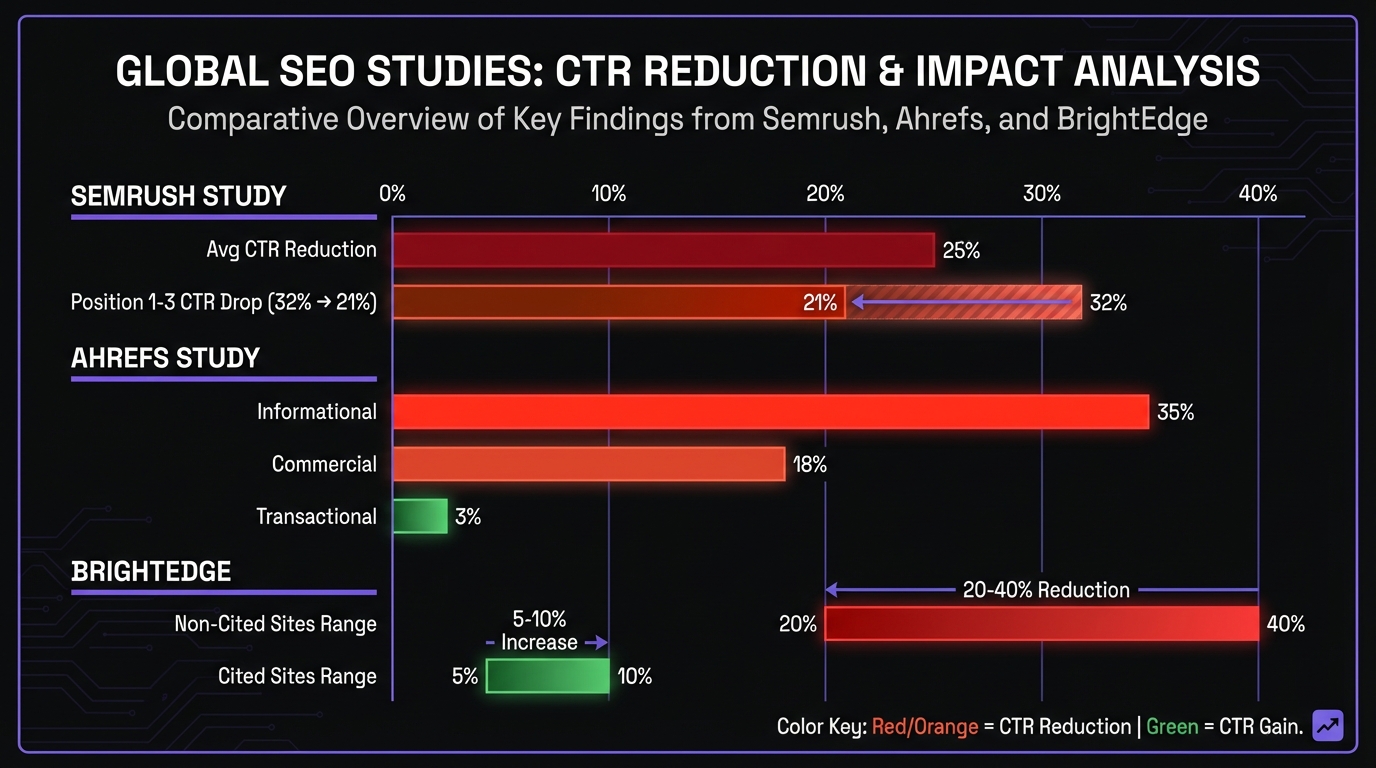
The aggregate data tells a nuanced story—not uniform devastation, but significant variance based on content type and industry. Major Research Findings: Semrush Study (Q1 2025):
- Analyzed 100,000+ domains over 6 months
- Average CTR reduction: 25% for queries with AI Overviews
- Wide variance: Some sites lost 60%, others gained 15%
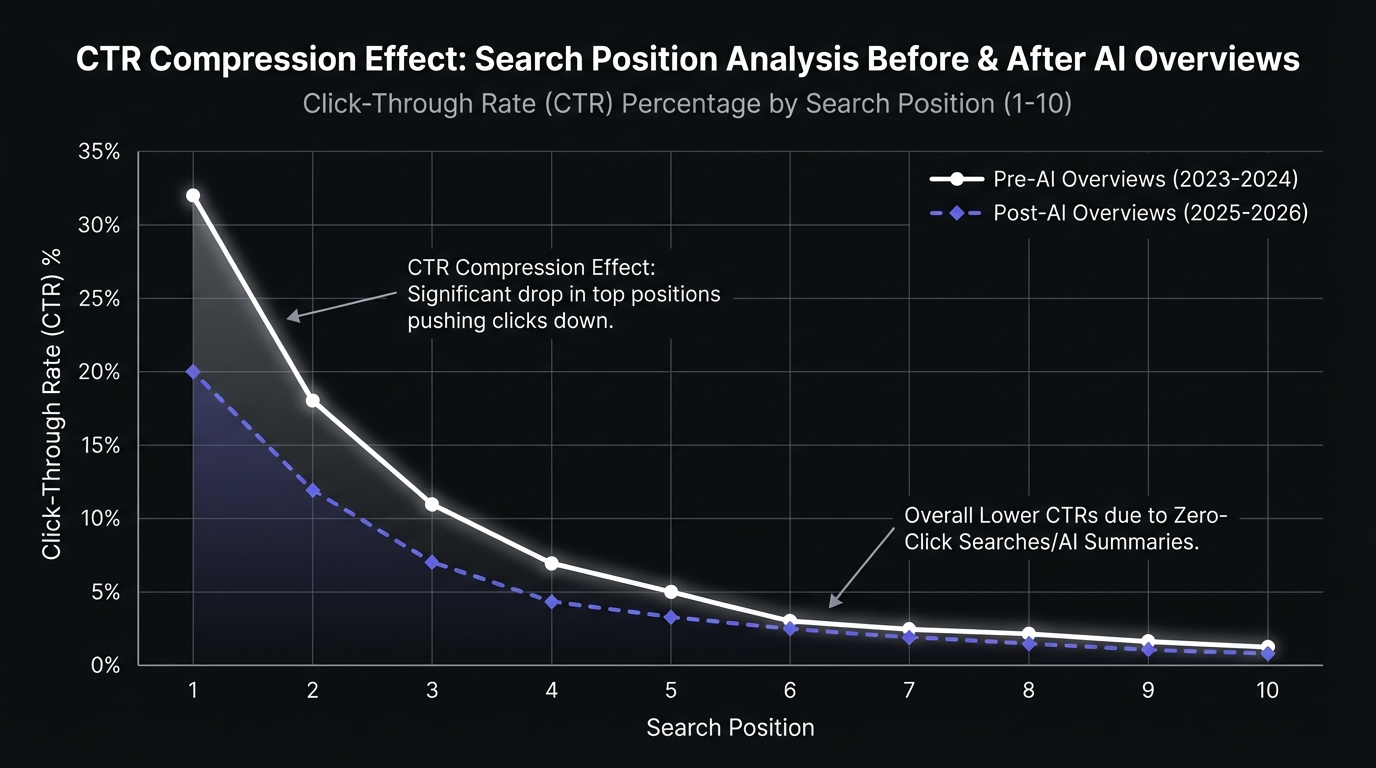
- Position 1-3 CTR dropped from 32% average to 21% average Ahrefs "State of AI Search" Report (Q3 2024):
- Examined 1M+ keywords
- Zero-click rate increased from 50% to 58% year-over-year
- Informational queries: 35% CTR reduction
- Commercial queries: 18% CTR reduction
- Transactional queries: Minimal impact (3% reduction) BrightEdge Ongoing Analysis:
- Real-time tracking across 10,000+ enterprise sites
- AI Overview visibility score now standard metric
- Sites cited frequently see 5-10% traffic increase from brand awareness
- Sites ranked but not cited: 20-40% traffic decrease for affected queries
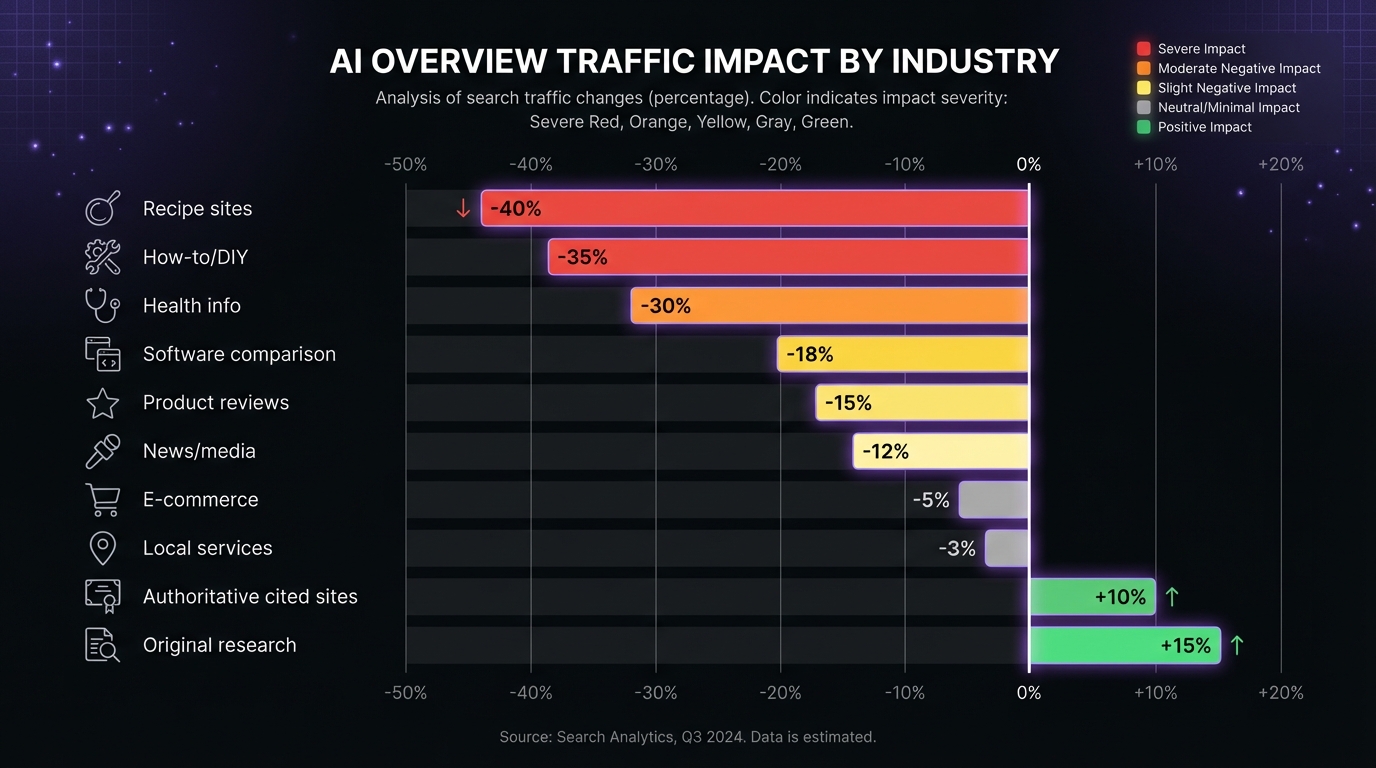
 Which Industries Are Hit Hardest:
Severe Impact (30-60% traffic loss for affected queries):
Which Industries Are Hit Hardest:
Severe Impact (30-60% traffic loss for affected queries): - Recipe and cooking sites
- How-to and DIY content sites
- Dictionary and definition sites
- Basic health information sites
- Simple tutorial sites Moderate Impact (15-30% traffic loss):
- Software comparison sites
- Product review sites
- Educational content
- News and media sites
- General information blogs Minimal Impact (0-15% traffic loss):
- E-commerce product pages
- Local service businesses
- SaaS and software landing pages
- Branded content sites
- Entertainment and media streaming Actually Gaining (5-15% traffic increase):
- Authoritative sites cited frequently in AI Overviews
- Niche expert sites with unique perspectives
- Original research publishers
- Deep technical documentation
- Analysis and opinion sites
Query-Level Impact Patterns
Understanding impact by query intent is crucial for prioritizing your response. Informational Queries: Largest Impact "What is..." queries: -40 to -60% CTR
- Example: "What is keyword research"
- Why..." queries**: -30 to -50% CTR
- Example: "How to check backlinks"
- Why: AI Overview outlines steps
- User behavior: 40-50% click for detailed instructions
- Mitigation: Emphasize unique methodology, visual guides "Why does..." queries: -25 to -40% CTR
- Example: "Why does my website rank poorly"
- Why..." queries**: -20 to -30% CTR
- Example: "Best SEO tool for agencies"
- Why. The Position 1-3 Problem Historical CTR Benchmarks (Pre-AI Overviews):
- Position 1: 28-35% CTR
- Position 2: 15-20% CTR
- Position 3: 10-13% CTR With AI Overviews (Current):
- Position 1: 15-25% CTR
- Position 2: 10-15% CTR
- Position 3: 6-9% CTR Featured Snippet Cannibalization:
- Featured snippets now often absorbed into AI Overviews
- Separate featured snippet appearance declining (down 30-40% in 2025)
- Featured snippet CTR also declined (from 8-12% to 4-7%)
- Trade-off: May be cited in AI Overview instead "People Also Ask" Displacement:
- PAA boxes appearing less frequently with AI Overviews
- PAA expansion behavior down 45%
- AI Overviews partially replacing PAA functionality Below-the-Fold Visibility Challenges:
- Average AI Overview height: 400-600px on desktop, 500-800px on mobile
- Positions 4-10 often entirely below fold on mobile
- Positions 1-3 may still be below fold on mobile with long AI Overview
- Increased importance of position 1-2 specifically Real GSC Example: CTR Changes for Position 1-3 Queries Looking at an anonymized technology blog's GSC data: Query: "how to do keyword research" (Position 1.2)
- Pre-AI Overview CTR (Jan-Jun 2024): 32%
- Post-AI Overview CTR (Jul-Dec 2024): 18%
- Current CTR (Q4 2025): 20%
- Analysis: Initial sharp decline, slight recovery as users learn when to click for depth Query: "what is domain authority" (Position 1.0)
- Pre-AI Overview CTR: 35%
- Post-AI Overview CTR: 12%
- Current CTR: 14%
- Analysis: Definition query fully answered in AI Overview; minimal recovery Query: "keyword research tools comparison" (Position 2.0)
- Pre-AI Overview CTR: 18%
- Post-AI Overview CTR: 14%
- Current CTR: 16%
- Analysis: Commercial intent preserved clicks; users want depth
Case Studies
Real-world examples illustrate the variance in AI Overview impact. Case Study 1: Recipe Site (-40% Traffic to AI Overview Queries) Site Profile:
- 500,000 monthly organic visits (pre-AI Overviews)
- Primary content: Recipe posts with instructions, ingredients, photos
- Monetization: Display ads, affiliate links Impact Timeline:
- May-June 2024: AI Overviews begin appearing on 60-70% of queries
- July-Aug 2024: Traffic decline begins
- Sept-Dec 2024: Continued decline (-15% additional)
- Total Impact: 40% decline in organic traffic by end of 2024 Query Analysis:
- Queries like "chocolate chip cookie recipe" now show full recipe in AI Overview
- Ingredient lists, cooking times, and basic instructions all visible without clicking
- AI Overview sources include 4-6 recipe sites, this site rarely cited **.. [150 words]
Why Keyword Research Matters (Context)
Understanding user intent... [300 words]
Step-by-Step Keyword Research Process (Depth)
- Identify your topics...
- Generate keyword ideas... [1,500 words with examples]
Advanced Keyword Research Strategies (Differentiation)
Semantic clustering, competitive gap analysis... [800 words]
This structure gives AI Overview what it needs for the summary while providing depth that earns citations and encourages clicks.
---
## Optimizing for AI Search
Concrete strategies to increase your visibility and citation rate in AI Overviews.
### E-E-A-T Becomes Even More Critical
Google's E-E-A-T framework (Experience, Expertise, Authoritativeness, Trust) is the foundation of AI Overview source selection.
**Experience: First-Hand Expertise Demonstration**
Show, don't just tell:
**Effective Experience Signals:**
- ✅ "I tested 15 different SEO tools over 6 months. What: I found..."
- ✅ Screenshots from your own accounts/tools
- ✅ Original photos and videos
- ✅ Case studies from your own clients/projects
- ✅ "In my 10 years of SEO consulting..." with specific examples
**Ineffective (No Experience Signals):**
- ❌ "SEO tools are important for improving rankings"
- ❌ Stock photos
- ❌ Generic advice with no attribution
- ❌ "Experts say..." without personal expertise
**Implementation:**
- Add author bios with credentials and photos
- Include personal anecdotes and examples
- Show real results, data, and screenshots
- Document your methodology and testing process
**Expertise: Author Credentials and Citations**
Demonstrate subject matter expertise:
**Effective Expertise Signals:**
- ✅ Author credentials displayed prominently
- ✅ Citations of your work by other authorities
- ✅ Industry awards and recognition
- ✅ Technical depth appropriate to topic
- ✅ References to industry standards and research
**Implementation:**
```html
<!-- Author Schema Example -->
<script type="application/ld+json">
{
"@context": "https://schema.org",
"@type": "Article",
"author": {
"@type": "Person",
"name": "Jane Smith",
"jobTitle": "Senior SEO Strategist",
"description": "10+ years experience in technical SEO and content strategy",
"url": "https://yoursite.com/about/jane-smith",
"sameAs": [
"https://www.linkedin.com/in/janesmith",
"https://twitter.com/janesmithseo"
]
}
}
</script>
Authoritativeness: Domain and Brand Authority Build authority at content and domain levels: Domain-Level Authority:
- High-quality backlink profile
- Brand mentions across authoritative sites
- Consistent publishing in your niche
- Domain age and history (if positive) Content-Level Authority:
- Cited by other authoritative sources
- Linked to from government, educational, or industry sites
- Referenced in discussions
- Expanded upon or challenged by others (sign of influence) Trust: Reliability and Security Build trust through transparency and security: Technical Trust Signals:
- ✅ HTTPS across entire site
- ✅ Clear privacy policy
- ✅ Terms of service
- ✅ Contact information easily accessible
- ✅ About page with company/author details Content Trust Signals:
- ✅ Fact-checking and citations
- ✅ Regular content updates (freshness)
- ✅ Corrections policy and updates note
- ✅ No deceptive ads or pop-ups
- ✅ Positive user reviews/testimonials Practical E-E-A-T Checklist:
- Author bios with credentials on all major content
- Author schema markup implemented
- Original images, screenshots, or videos in each article
- External citations to authoritative sources
- Internal linking to related expertise content
- Regular content audits and updates
- Clear about page and contact information
- Privacy policy and legal pages
- HTTPS enabled site-wide
- Backlink profile audit
- Brand mentions and PR efforts ongoing
- User review/testimonial collection
Content Structure for AI Consumption
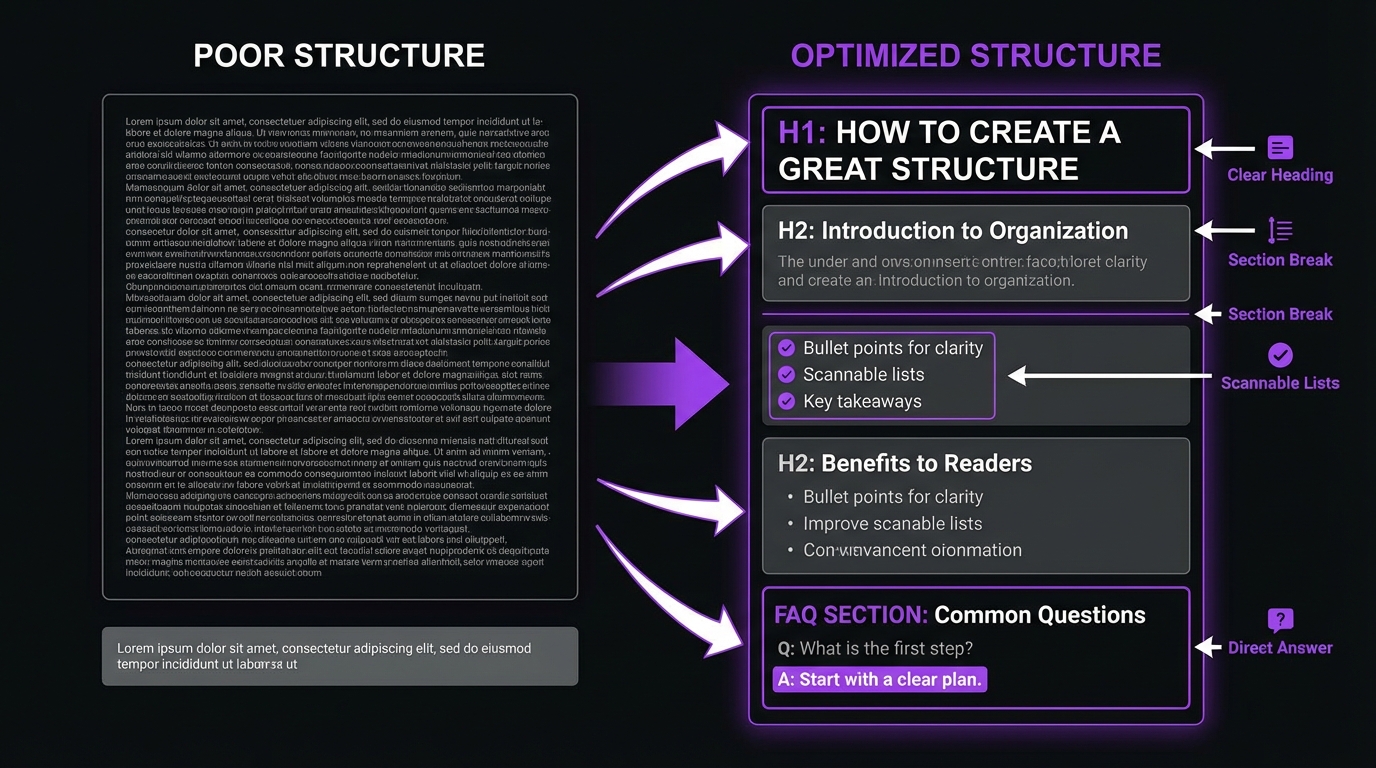
How you structure your content affects AI Overview source selection and citation likelihood. Clear, Hierarchical Structure (H2, H3 Importance) AI models parse content hierarchically: Best Practices:
# Main Title (H1) - Clear, descriptive, includes primary keyword
## Primary Section (H2) - Key topic area
Content directly addressing the H2 topic...
### Subsection (H3) - Specific aspect of H2
Detailed explanation...
### Another Subsection (H3)
More detail...
## Next Primary Section (H2)
**It helps website owners understand what their audience is looking for and optimize content accordingly. [Continue with depth below...]
**Why This Works:**
- AI can extract clear answer for Overview
- Users scanning get immediate value
- Demonstrates you directly answer the query
**Supporting Detail and Depth Below**
After the clear answer, provide comprehensive detail:
**Layered Depth Approach:**
1. **Brief answer** (50-100 words) - AI Overview extraction
2. **Expanded explanation** (200-300 words) - Context and importance
3. **Detailed guide** (1,000-2,000 words) - How-to, examples, advanced topics
4. **Related topics** (300-500 words) - Connected concepts, FAQs
This structure satisfies both AI extraction needs and user depth needs.
**Source Attribution in Your Own Content**
Citing sources improves your own E-E-A-T:
**Best Practices:**
- Link to authoritative sources for claims and data
- Credit original research and studies
- Reference Google's own documentation where relevant
- Use inline citations: "According to [Source], [fact]..."
**Benefits:**
- Builds trust with readers
- Signals research quality to AI
- Creates reciprocal citation opportunities
- Demonstrates thoroughness
### Structured Data & Schema Markup
Structured data helps AI understand and extract your content.
**Most Important Schema Types for AI**
**1. Article Schema** (Foundation for all content)
```json
{
"@context": "https://schema.org",
"@type": "Article",
"headline": "Complete Guide to Keyword Research",
"description": "find and analyze keywords...",
"image": "https://yoursite.com/images/keyword-research-guide.jpg",
"author": {
"@type": "Person",
"name": "Jane Smith",
"jobTitle": "SEO Strategist"
},
"publisher": {
"@type": "Organization",
"name": "Your Company",
"logo": {
"@type": "ImageObject",
"url": "https://yoursite.com/logo.png"
}
},
"datePublished": "2026-01-15",
"dateModified": "2026-01-21"
}
2. FAQPage Schema (Strategic Use for Q&A Content)
{
"@context": "https://schema.org",
"@type": "FAQPage",
"mainEntity": [{
"@type": "Question",
"name": "What is keyword research?",
"acceptedAnswer": {
"@type": "Answer",
"text": "Keyword research is the process of discovering and analyzing the search terms that people enter into search engines. It involves identifying relevant keywords, understanding search volume and competition, and selecting terms that align with your content strategy and business goals."
}
}, {
"@type": "Question",
"name": "Why is keyword research important?",
"acceptedAnswer": {
"@type": "Answer",
"text": "Keyword research is important because it reveals what your target audience is searching for, create content that matches user intent, uncovers content opportunities competitors may have missed, and provides data to prioritize SEO efforts for maximum ROI."
}
}]
}
When to Use FAQ Schema:
- Your content naturally includes Q&A format
- You're answering common user questions
- You want to increase chances of AI Overview extraction When NOT to Use:
- Forcing Q&A format where it doesn't fit naturally
- Every page (use selectively)
- For marketing fluff instead of genuine questions 3. HowTo Schema (For Procedural Content)
{
"@context": "https://schema.org",
"@type": "HowTo",
"name": "How to Conduct Keyword Research",
"description": "Step-by-step guide to finding and analyzing keywords",
"totalTime": "PT30M",
"step": [{
"@type": "HowToStep",
"name": "Brainstorm seed keywords",
"text": "Start by listing 5-10 broad topics relevant to your business or content. These seed keywords form the foundation of your research.",
"url": "https://yoursite.com/keyword-research-guide#step-1"
}, {
"@type": "HowToStep",
"name": "Use keyword research tools",
"text": "Enter your seed keywords into tools like Google Keyword Planner, Ahrefs, or Semrush to discover related terms, search volumes, and difficulty scores.",
"url": "https://yoursite.com/keyword-research-guide#step-2"
}]
}
Benefits:
- Structures process for AI understanding
- Can appear in how-to rich results
- Improves AI Overview extraction of steps 4. Speakable Schema (Consideration) Speakable schema indicates content suitable for voice assistants:
{
"@context": "https://schema.org",
"@type": "Article",
"speakable": {
"@type": "SpeakableSpecification",
"cssSelector": [".key-takeaways", ".summary"]
}
}
Current Status:
- Limited direct impact on AI Overviews (as of 2026)
- May become more relevant as voice search integrates with AI
- Use selectively, not required for all content Schema Implementation Tips:
- Validate all schema with Google's Rich Results Test tool
- Keep schema updated when content changes
- Don't mark up content that isn't on the page (spam)
- Use most specific applicable schema type
- Combine multiple schema types when appropriate
Comprehensive Topic Coverage
Becoming the definitive resource on a topic increases AI Overview citation likelihood. Topic Cluster Model Importance Organize content into interconnected topic clusters: Hub and Spoke Model:
Pillar Page: "Complete Guide to SEO"
↓
├─ Cluster: "Keyword Research Tutorial"
├─ Cluster: "On-Page Optimization Checklist"
├─ Cluster: "Link Building Strategies"
├─ Cluster: "Technical SEO Fundamentals"
└─ Cluster: "SEO Analytics and Measurement"
Benefits:
- Signals topical authority to Google
- Internal linking distributes authority
- Covers topic comprehensively
- Multiple entry points for users
- Better chance of citation for any query in topic area Covering User Questions Exhaustively Anticipate and answer all related questions: Research Method:
- Use "People Also Ask" box on Google
- Check "Related Searches" at bottom of SERP
- Use AnswerThePublic or AlsoAsked tools
- Review competitor content
- Analyze your own site search data (if available) Example for "Keyword Research" Topic:
- What is keyword research?
- Why is keyword research important?
- How to do keyword research step by step?
- What tools are best for keyword research?
- How long does keyword research take?
- What is keyword difficulty?
- What is search volume?
- How many keywords should I target?
- How to find long-tail keywords?
- What is keyword cannibalization? Implementation:
- Create comprehensive pillar content addressing all main questions
- Create cluster posts diving deep into specific subtopics
- Use FAQ sections to address quick questions
- Implement FAQ schema for structured Q&A Internal Linking Strategy for Authority Strategic internal linking builds topical authority: Best Practices:
- Link from pillar page to all related cluster posts
- Link from cluster posts back to pillar
- Use descriptive anchor text: "Learn more about [specific topic]" not "click here"
- Aim for 3-5 internal links per article
- Link to your most authoritative content prominently Example Internal Linking Structure:
Pillar: SEO Guide
→ "For detailed keyword research strategies, see our [Keyword Research Tutorial]"
Cluster: Keyword Research Tutorial
→ "This is part of our comprehensive [SEO Guide]"
→ "After identified keywords, learn about [On-Page Optimization]"
Creating "Ultimate Guides" That AI Cites Characteristics of highly-cited content:
- Comprehensive: 3,000-7,000+ words covering topic exhaustively
- Well-structured: Clear hierarchy, scannable format
- Visual: Diagrams, screenshots, examples throughout
- Up-to-date: Regular updates, current year referenced
- Original: Unique insights, not rehashed generic advice
- Expert: Clear author credentials and first-hand experience
- Practical: Actionable steps, not theory ### Brand Building in the AI Era As direct search traffic potentially declines, brand strength becomes your competitive moat. Why Branded Searches Are Your Moat AI Overviews have minimal impact on branded searches:
- Users searching your brand name want YOUR site
- Navigational intent preserved in AI era
- Branded queries = direct traffic regardless of SERP features Data:
- Branded search CTR remains 80-90% even with AI Overviews
- Non-branded search CTR down to 15-25% for affected queries
- Investment in brand = protection against algorithm changes Building Brand Recognition Outside Search Reduce dependence on Google by building brand awareness through other channels: Effective Channels:
- LinkedIn/Social Media: Thought leadership, share insights
- Email Newsletter: Build owned audience
- Podcasts: Guest appearances or own show
- Industry Events: Speaking, sponsorships
- PR and Media: Get featured in publications
- Community Building: Forums, Slack groups, Discord
- YouTube: Video content, tutorials
- Partnerships: Collaborations with complementary brands Goal: When people need your solution, they search your brand directly, not generic terms. Creating Unique, Un-Replicable Content Content that AI can't easily synthesize or replicate: Types of Content AI Can't Replace:
- Original Research and Data
- Surveys you conduct
- Proprietary data analysis
- Industry studies
- Benchmark reports
- First-Hand Experience and Case Studies
- Your specific client results
- Your testing and experiments
- Your methodology and process
- Your failures and lessons learned
- Expert Opinion and Analysis
- Your unique perspective on industry trends
- Controversial or contrarian takes (backed by reasoning)
- Predictions based on your experience
- Analysis synthesizing multiple sources
- Community and User-Generated Content
- User reviews and testimonials
- Community discussions and forums
- Crowd-sourced insights
- User-submitted examples Example: Instead of "10 SEO Tips" (generic, AI can synthesize), create:
- "2026 SEO Trends: Analysis of 1,000 Client Sites" (original data)
- "Why I Stopped Recommending [Common Strategy]" (unique perspective)
- "6-Month Experiment: Testing [Hypothesis] with Real Data" (first-hand testing)
Technical SEO Fundamentals
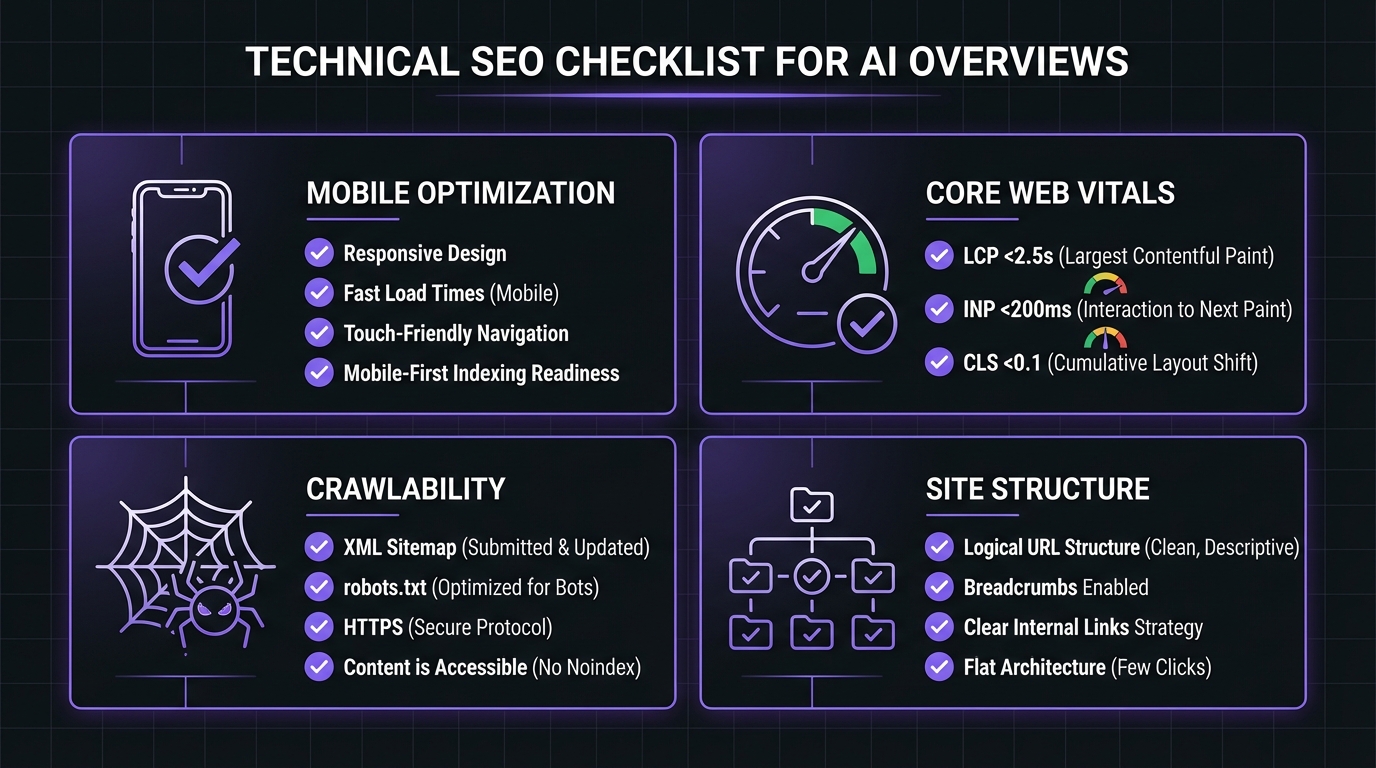
E-E-A-T and content are critical but technical foundation remains essential. Mobile-First is Non-Negotiable AI Overviews rolled out mobile-first; mobile optimization is critical: Requirements:
- Responsive design
- Fast mobile load times (<3 seconds)
- Touch-friendly navigation and buttons
- Readable text without zooming
- No intrusive interstitials or pop-ups
- Viewport properly configured Core Web Vitals Still Matter Google's user experience metrics remain ranking factors and affect AI Overview source selection: Key Metrics:
- LCP: <2.5 seconds (good)
- FID (First Input Delay): <100ms (good) / INP: <200ms (good)
- CLS: <0.1 (good) Why It Matters for AI:
- User experience signals factor into source selection
- Fast, stable pages signal quality and reliability
- Poor Core Web Vitals may disqualify you from citations Test: Use Google PageSpeed Insights and Search Console Core Web Vitals report Crawlability and Indexability AI can only cite content Google can crawl and index: Essential Checklist:
- No robots.txt blocking important content
- XML sitemap submitted to Search Console
- HTTPS enabled site-wide
- No orphaned pages
- No redirect chains or loops
- Canonical tags properly implemented
- No soft 404s or server errors
- JavaScript content properly rendered Structured Content Organization Logical site architecture helps Google understand your content: Best Practices:
- Clear URL structure:
/blog/category/post-title - Breadcrumb navigation
- Internal linking between related content
- Clear header navigation
- Logical content hierarchy
Measuring AI Overview Visibility
You can't optimize what you don't measure. To track your AI Overview performance.
Current Measurement Challenges
GSC Doesn't Separate AI Overview Impressions (Yet) As of early 2026, Google Search Console does not distinguish between:
- Traditional organic impressions
- AI Overview impressions
- AI Overview clicks Why This Is Challenging:
- Can't directly measure AI Overview citation rate
- Can't attribute traffic changes definitively to AI Overviews
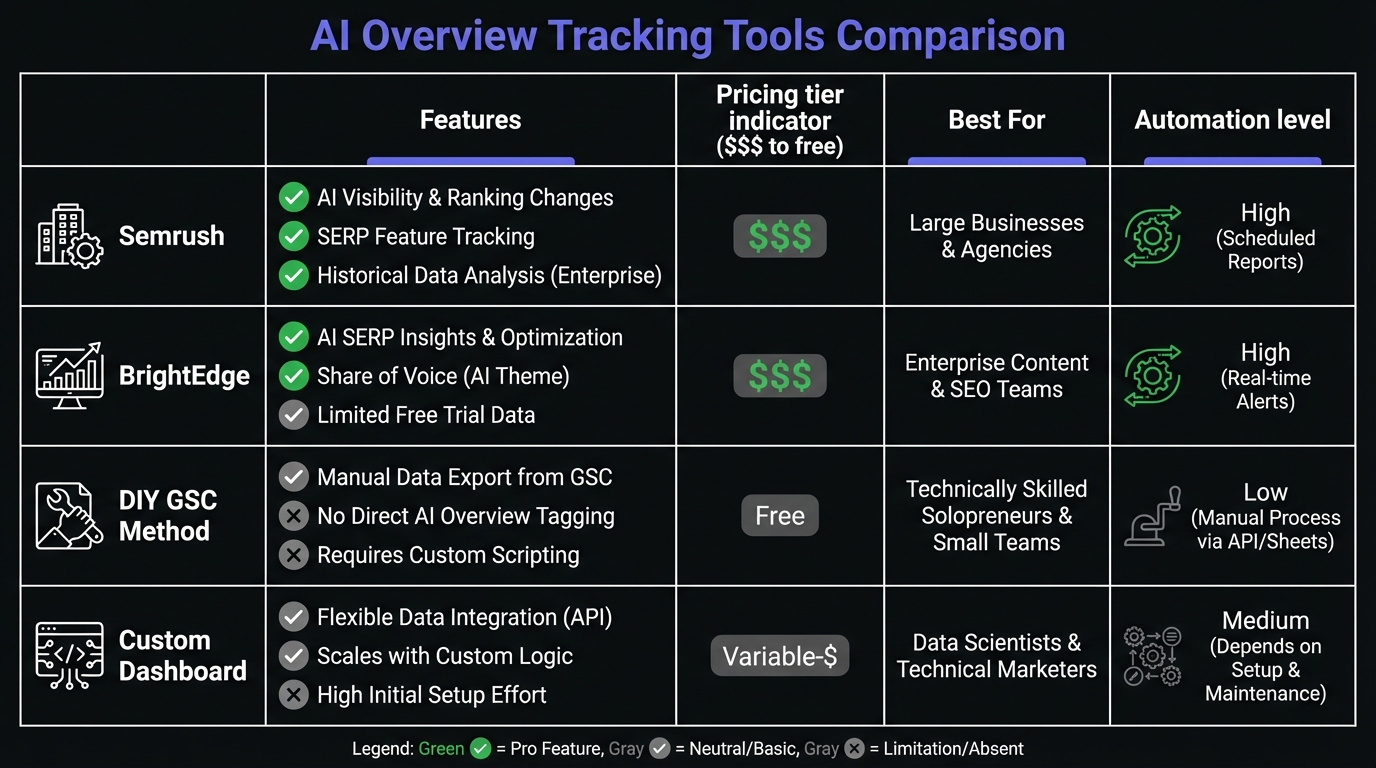
- Can't optimize with precision for AI Overview appearance Workaround: Indirect measurement using CTR patterns and query analysis) Third-Party Tools Limitations Current third-party SEO tools are adding AI Overview tracking:
- Semrush. Identifying Queries Likely Showing AI Overviews Pattern analysis helps identify affected queries: High-Probability AI Overview Query Patterns:
- Contains "how to"
- Contains "what is" or "what are"
- Contains "best" + [category]
- Contains "vs" (comparison)
- Contains "[topic] guide"
- Long-tail informational queries (5+ words) GSC Methodology:
- Navigate to Performance Report in GSC
- Click "Queries" tab
- Export query data (last 16 months for trends)
- In spreadsheet, filter for patterns above
- Calculate percentage of impressions from "AI-likely" queries CTR Analysis for High-Ranking Queries CTR depression indicates AI Overview presence: Method:
- In GSC, filter for queries where Average Position is <4 (top 3)
- Look at CTR for these high-ranking queries
- Compare to historical CTR benchmarks:
- Position 1: Expected 28-35% without AI, 15-25% with AI
- Position 2: Expected 15-20% without AI, 10-15% with AI
- Position 3: Expected 10-13% without AI, 6-9% with AI
- Significant CTR below historical benchmarks suggests AI Overview impact Time-Based Comparison:
- In GSC, compare date ranges:
- Earlier period (e.g., Jan-Jun 2024)
- Later period (e.g., Jul-Dec 2025)
- For same queries at same positions, note CTR changes
- CTR decline at consistent positions = AI Overview effect Impression Changes for Informational Queries Track impression trends for likely-affected queries: Method:
- Filter GSC for informational query patterns (how-to, what-is, etc.)
- Compare impressions month-over-month
- Stable or growing impressions but declining clicks = AI Overview satisfying users
- Declining impressions = potential ranking drop (separate issue) Device-Level Analysis (Mobile-First Rollout) Mobile vs desktop comparison reveals AI impact: Method:
- In GSC, filter by device (Mobile vs Desktop)
- Compare CTR for same queries across devices
- If mobile CTR significantly lower than desktop = likely AI Overview impact (mobile-first rollout)
- As AI Overviews expand to desktop, gap should narrow
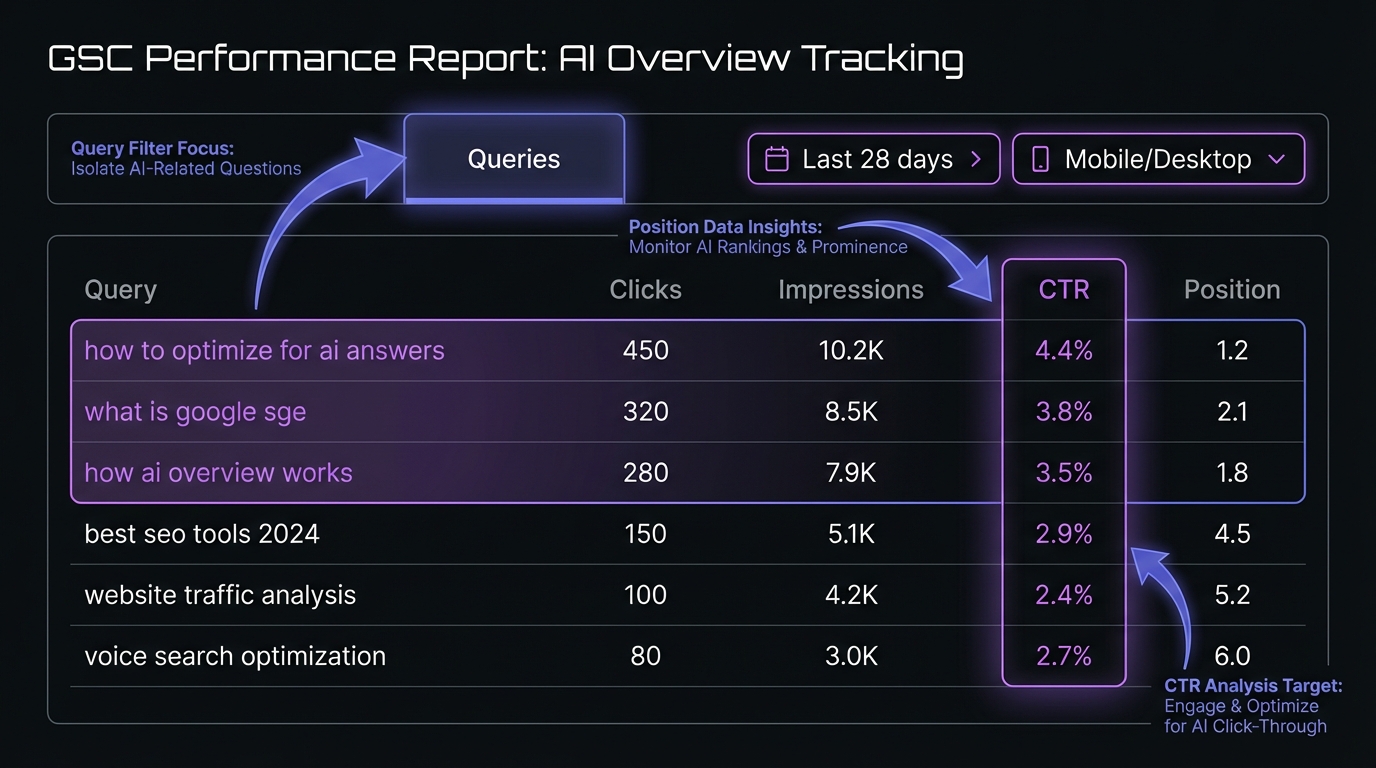 For step-by-step methodology with screenshots and a downloadable tracking dashboard, see our complete tutorial: How to Track AI Overview Visibility Using GSC
Third-Party Tracking Tools
Overview of available tools and features: Semrush AI Overview Tracking
- Features: Tracks AI Overview appearance for monitored keywords, shows citation frequency
- Pros: Automated tracking, historical data, integrated with other Semrush metrics
- Cons: Limited to tracked keywords (quota based on plan), doesn't cover all your queries
- Best for: Agencies and businesses already using Semrush for SEO BrightEdge AI Visibility Score
- Features: Proprietary score measuring AI Overview presence, citation frequency, competitive comparison
- Pros: Enterprise-grade analytics, sophisticated reporting, historical trending
- Cons: Enterprise pricing ($1,000+/month), complexity, overkill for small businesses
- Best for: Large enterprises with significant SEO investment Ahrefs and Other Tools
- Current state: Most tools adding AI Overview features in 2026
- What to expect: Keyword-level AI Overview appearance tracking, citation analysis, competitor comparison
- Timeline: Likely widely available by mid-2026
Creating a Measurement Dashboard
Key Metrics to Track Primary Metrics (Weekly):
- AI-Likely Query Impressions: % of total impressions from informational queries
- Average CTR (Position 1-3): For AI-likely queries vs all queries
- Top 20 Query CTR Trend: Track your most important queries Secondary Metrics (Monthly):
- Manual Citation Rate: % of spot-checked queries where you're cited in AI Overview
- Device CTR Gap: Mobile vs desktop CTR difference
- Impression Trends: Month-over-month changes for AI-likely queries
- Top Pages Impact: Which pages/content most affected Baseline Establishment Before you can track changes, establish your SEO baseline:
- Export 16 months of GSC data (if available)
- Calculate all metrics above for 6-12 months ago (pre-AI or early AI)
- Document baseline numbers
- Use as comparison point for future measurements Alert Thresholds Set up alerts for significant changes:
- Critical Alert: >20% CTR drop for top 20 queries
- Warning: >10% CTR drop for any segment (review within week)
- Positive Signal: >15% increase in citation rate Reporting Cadence Recommended tracking schedule:
- Daily: Quick check of overall traffic (Google Analytics)
- Weekly: GSC CTR check for top queries
- Monthly: Full dashboard review, manual spot checks, trend analysis
- Quarterly: guide, competitive analysis, strategy adjustment
Future-Proofing Your SEO Strategy
As search continues to evolve, diversification and adaptability are key to long-term success.
Diversification is Key
Don't Rely Solely on Google Organic Over-dependence on any single traffic channel creates vulnerability: Diversification Strategy: 1. Build Email Lists and Owned Audiences
- Email subscribers = owned channel, not algorithm-dependent
- Newsletter provides direct communication
- Aim for 10-20% of website visitors to join email list
- Nurture with valuable content, not promotional material 2. Leverage Social Platforms
- LinkedIn for B2B and professional content
- Twitter/X for real-time engagement and industry discussion
- YouTube for video content and tutorials
- Instagram/TikTok for visual content and brand building
- Choose 2-3 platforms where your audience is most active 3. Consider Alternative Search Engines
- Bing/Microsoft Ecosystem
- DuckDuckGo
- Emerging AI search tools (Perplexity, You.com)
- Optimization for Google generally benefits other search engines 4. Direct Traffic and Brand Building
- Branded searches unaffected by AI Overviews
- Build brand recognition so people search for you specifically
- Offline marketing, partnerships, PR all contribute
- Goal: Reduce % of traffic from non-branded organic search Traffic Mix Goal: Instead of 80% Google organic, aim for:
- 40-50% Google organic (diversified queries)
- 15-20% Direct and branded search
- 15-20% Email and newsletter
- 10-15% Social media
- 5-10% Other search engines and referrals
Embrace the Shift to Brand
AI Overviews make brand building more important than ever. Investing in Brand Awareness Tactics:
- Content marketing: Thought leadership articles, research, insights
- PR and media: Get featured in industry publications
- Speaking engagements: Conferences, webinars, podcasts
- Partnerships: Collaborate with complementary brands
- Sponsorships: Industry events, newsletters, podcasts
- Advertising: Targeted brand awareness campaigns ROI Measurement:
- Track branded search volume (Google Trends, GSC)
- Monitor direct traffic growth
- Survey customers: "How did you hear about us?"
- Social listening: Brand mentions and sentiment Thought Leadership Content Establish your brand as the go-to expert: Content Types:
- Original research: Industry surveys, data analysis, trend reports
- Expert commentary: Analysis of industry news and developments
- Contrarian perspectives: Well-reasoned challenges to conventional wisdom
- Future predictions: Based on data and experience, not speculation
- Comprehensive guides: Become the definitive resource Distribution:
- Publish on your site (owned content)
- Syndicate to Medium, LinkedIn
- Pitch to industry publications
- Share on social media with insights
- Present at conferences Community Building Create spaces where your audience gathers: Options:
- Slack or Discord community: For ongoing discussion
- Forum or Q&A section: On your website
- LinkedIn Group: Professional networking
- Live events: Virtual or in-person meetups
- User conferences: Annual gathering for customers/community Benefits:
- Direct relationship with audience
- Feedback and insights for product/content development
- Organic word-of-mouth growth
- Reduced dependence on search algorithms
Content Differentiation Strategies
Creating content that stands out and can't be easily replicated or synthesized by AI. Original Research and Data The most valuable content in the AI era: Types of Original Research:
- Surveys: Poll your audience or industry
- Data analysis: Analyze your proprietary data or public datasets
- A/B testing results: Share what you've tested and learned
- Case studies: Document real results with clients/projects
- Benchmark reports: Compare metrics across your customer base Why This Works:
- AI can't access your proprietary data
- Original insights can't be synthesized from existing content
- Media and other sites will cite your research (backlinks)
- Establishes authority and expertise Example: "2026 SEO Benchmark Report: Analysis of 1,000 E-commerce Sites" Expert Perspectives and Analysis Your unique interpretation and insights: Approaches:
- Trend analysis: "Why [trend] will/won't last and what it means for you"
- Myth busting: "Why [common advice] is outdated/wrong"
- Deep dives: Go deeper than anyone else on a topic
- Synthesis: Connect ideas from multiple domains
- Predictions: Based on your experience and data Multimedia Content (Video, Audio, Interactive) Formats less easily consumed or synthesized by AI search: Video Content:
- Tutorials and screen recordings
- Expert interviews
- Behind-the-scenes documentation
- Webinars and presentations
- Short-form for social Audio Content:
- Podcast series
- Audio articles
- Voice-based Q&A Interactive Content:
- Calculators and tools
- Quizzes and assessments
- Interactive visualizations
- Configurators Benefits:
- Users must visit your site to engage
- More engaging than text alone
- Harder for AI to extract full value
- Better user experience and retention Community-Generated Content Leverage your audience: Types:
- User reviews and ratings
- Discussion forums and comments
- User-submitted examples and case studies
- Crowdsourced tips and advice
- Q&A sections (like Stack Overflow) Benefits:
- Scales content creation
- Authentic, first-hand perspectives
- Fresh, regularly updated content
- Community investment and loyalty
Preparing for What's Next
The AI search landscape will continue to evolve rapidly. Voice Search Integration with AI Voice assistants increasingly powered by AI:
- Google Assistant with Gemini integration
- Siri with enhanced AI capabilities
- Alexa evolution
- Voice queries more conversational and complex Optimization Considerations:
- Natural language content (conversational tone)
- Direct answer format
- Local optimization
- Featured snippet optimization Multimodal Search (Visual + Text) Search evolving beyond text:
- Google Lens visual search
- AI-powered image understanding
- Search by screenshot or photo
- Combined visual + text queries Optimization Considerations:
- Image optimization
- Visual content quality
- Context around images Personalized AI Assistants AI assistants learning user preferences:
- ChatGPT with memory
- Google AI personalization
- Enterprise AI assistants
- Industry-specific AI tools Implications:
- Brand consistency across touchpoints matters more
- Being cited in AI = being "learned" by AI assistants
- Direct relationships (email, accounts) increasingly valuable Search Beyond the SERP AI search integrated everywhere:
- Within apps and platforms (not just Google.com)
- Browser search bars with AI
- AI chat interfaces replacing traditional search
- Voice-activated search in cars, homes, devices Strategic Response:
- Focus on being a trusted, authoritative source
- Structured data for AI understanding
- Brand building for direct access
- Diversified content formats and distribution
Beyond Google: The Broader AI Search Landscape
Google dominates but other AI search platforms present opportunities.
ChatGPT and OpenAI Search
How ChatGPT Search Works As of late 2025, ChatGPT offers real-time web search:
- Available to Plus and Team subscribers
- Browses web for current information
- Cites sources with clickable links
- Conversational follow-up questions Source Attribution and Linking ChatGPT's citation style:
- Inline citations with superscript numbers [1]
- Source list at bottom of response
- Clickable links to original sources
- Transparent about when it used web search Optimization Considerations What works for ChatGPT:
- Clear, authoritative content
- Structured, well-organized information
- Recency
- Comprehensive coverage (cited for depth) Key Difference from Google:
- Less emphasis on backlinks (newer consideration)
- Conversational context matters (multi-turn)
- Subscriber base Should You Optimize Specifically for ChatGPT?
- If you optimize well for Google AI Overviews, you're 80% there for ChatGPT
- Monitor your brand mentions in ChatGPT responses
- Unique ChatGPT optimization not yet necessary for most sites
Perplexity AI
Academic and Professional Use Cases Perplexity positioned as research-focused AI search:
- Emphasis on citations and sources
- Academic and professional user base
- Growing among researchers, analysts, journalists
- 50M+ monthly users (as of Q4 2025) Citation Style and Opportunities Perplexity's approach:
- Multiple citations per fact
- Academic-style citation format
- Follow-up questions encourage deep dives
- Source transparency Optimization Considerations:
- Very similar to Google AI Overview optimization
- Extra emphasis on credibility and citations
- Technical and in-depth content performs well
- Niche authority can outperform general sites
Bing Copilot
Microsoft's Search Integration Bing Copilot (formerly Bing Chat):
- Integrated across Microsoft 365 products
- Available to Edge browser users by default
- Growing presence in enterprise environments Enterprise and Productivity Focus Key differentiation:
- B2B and enterprise user base
- Integration with Word, Excel, Outlook
- Commercial intent often higher
- Professional and business queries Optimization Considerations:
- B2B content especially valuable
- Professional tone and depth
- Integration with Microsoft ecosystem
- Worth monitoring for enterprise businesses
Emerging AI Search Tools
You.com, Metaphor, and Other Startups Multiple startups entering AI search space:
- You.com: Privacy-focused, customizable
- Metaphor: Research and academic focus
- Phind: Developer and technical focus
- Others emerging regularly Niche and Specialized AI Search Trend toward specialized AI search:
- Legal research AI
- Medical information AI
- Code and developer AI
- Academic research AI Opportunity: If your niche has specialized AI search, early optimization may provide advantage
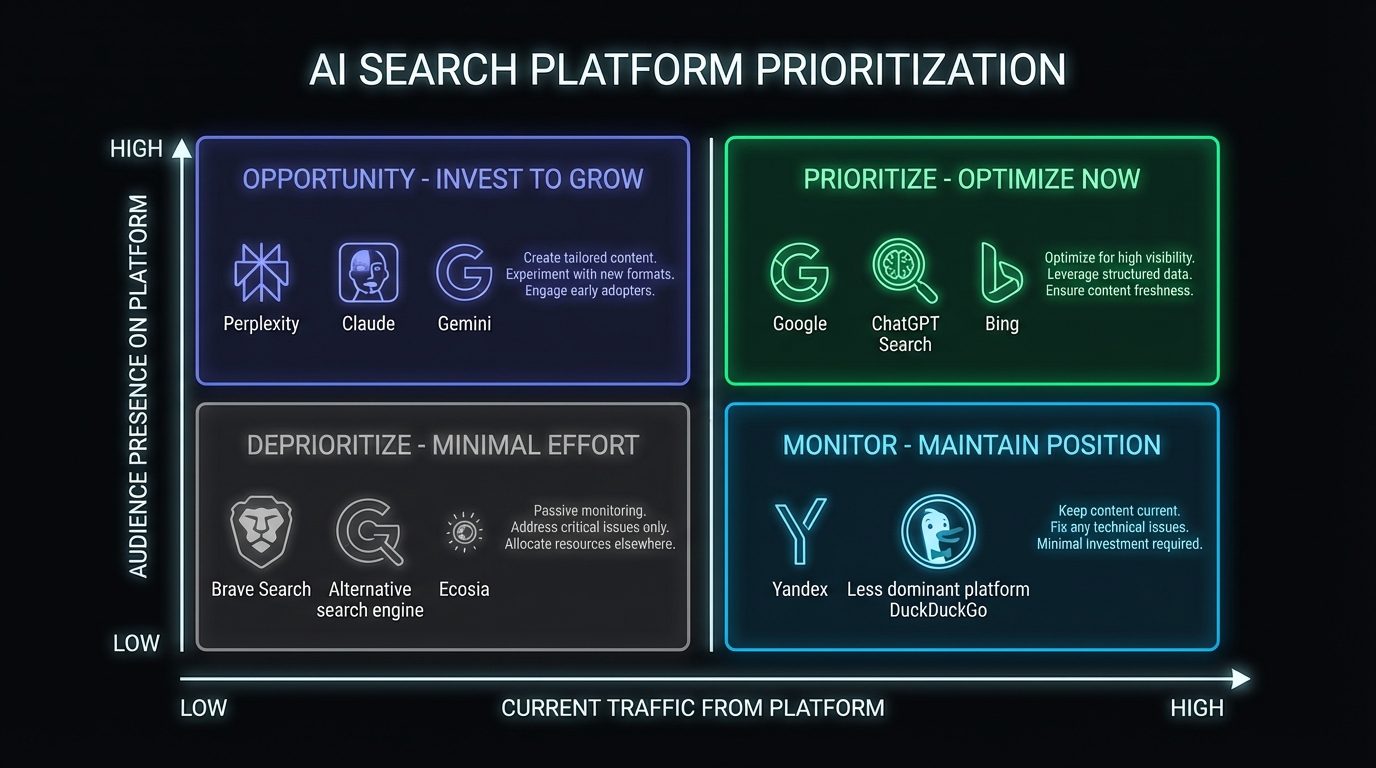
Should You Optimize for Non-Google AI?
Decision Framework Consider optimizing beyond Google if:
- ✅ Your audience is active on alternative platforms
- ✅ B2B business with Microsoft/Bing enterprise users
- ✅ Academic or research focus (Perplexity)
- ✅ You have resources after Google optimization is solid
- ✅ You're seeing meaningful traffic from alternative sources Skip extra optimization if:
- ❌ Limited resources
- ❌ B2C local business (Google dominates)
- ❌ No evidence of audience on alternative platforms
- ❌ Still building foundational content and authority Effort vs Opportunity Analysis The good news: Core optimization principles apply across all AI search platforms:
- E-E-A-T signals
- Comprehensive, structured content
- Clear expertise and authority
- Proper technical foundation
Recommendation: Optimize for Google AI Overviews, monitor performance on other platforms, invest specifically in alternatives only if data justifies it.
Action Plan: Adapting Your SEO Strategy
Prioritized roadmap for implementation.
Immediate Actions (Next 30 Days)
1. Audit E-E-A-T Signals Week 1-2:
- Review top 20 pages for author credentials
- Add/update author bios with expertise signals
- Implement author schema markup
- Audit about page and contact information
- Check HTTPS implementation site-wide
- Review backlink profile, disavow spammy links if needed 2. Implement/Audit Structured Data Week 2-3:
- Audit current schema implementation
- Implement Article schema on all main content
- Add FAQ schema to appropriate content
- Add HowTo schema to tutorial content
- Validate all schema (ensure no errors)
- Submit sitemap to GSC to ensure crawling 3. Identify High-Exposure Queries Week 3:
- Export GSC query data (last 28 days)
- Categorize queries
- Calculate % of traffic from "AI-likely" queries
- Identify top 20 queries by impression volume
- Document which are most vulnerable to AI Overviews 4. Establish Measurement Baseline Week 4:
- Document current metrics:
- Overall CTR
- Position 1-3 CTR for AI-likely queries
- Top 20 query CTR
- Device-level CTR (mobile vs desktop)
- Set up simple tracking spreadsheet
- Perform manual spot checks (5-10 top queries)
- Document current AI Overview citation rate Downloadable Resource: 30-Day AI Search Adaptation Checklist - Complete PDF with detailed tasks, resources, and tracking templates
Short-Term Strategy (3-6 Months)
Content Audit and Optimization Months 1-2:
- Audit existing content for E-E-A-T signals
- Identify top 10-20 pieces of content by traffic
- Update with:
- Enhanced expertise signals
- Deeper, more comprehensive information
- Better structure (headings, organization)
- Original examples and data
- Current information (update dates)
- Implement structured data on priority content
- Improve internal linking between related content
- Follow our content optimization strategy using GSC data Topic Cluster Development Months 2-4:
- Identify 3-5 core topic areas
- Map current content to topic clusters
- Identify content gaps
- Create pillar pages for core topics
- Develop cluster content for depth
- Implement strategic internal linking Brand Building Initiatives Months 1-6:
- Launch or optimize email newsletter
- Develop 1-2 pieces of original research
- Increase social media presence (choose 2 platforms)
- Guest post on authoritative sites in your niche
- Start podcast or YouTube channel (if resources allow)
- Build relationships with industry influencers Measurement Dashboard Setup Month 2:
- Create comprehensive tracking dashboard
- Automate data collection where possible
- Set up weekly/monthly reporting cadence
- Establish alert thresholds
- Share dashboard with team/stakeholders
Long-Term Strategy (6-12 Months)
Thought Leadership Positioning Months 6-12:
- Publish quarterly original research reports
- Develop unique perspective/methodology/framework
- Speak at industry conferences
- Get featured in major industry publications
- Build reputation as go-to expert in specific niche Original Research Program Ongoing:
- Conduct annual or bi-annual industry survey
- Analyze and publish your proprietary data
- Develop benchmark reports
- Create annual "State of [Industry]" report
- Use research for media attention and backlinks Audience Diversification Months 6-12:
- Grow email list to 10,000+ subscribers (if B2B) or appropriate size for your niche
- Build engaged social media following
- Launch community
- Diversify traffic sources
- Develop owned media properties Continuous Adaptation Ongoing:
- Monthly review of AI Overview impact data
- Quarterly strategy adjustment based on data
- Stay informed on Google AI developments
- Test and iterate on optimization tactics
- Monitor competitive landscape
- Adapt to new search behaviors and tools
- Use our SEO performance diagnosis framework to identify and address issues quickly
Conclusion: Opportunity in Change
The AI search revolution is not the death of SEO—it's an evolution that rewards quality, expertise, and authentic value. Key Realizations: AI Search is Not the End, It's a Shift
- SEO has survived every algorithm update, feature addition, and interface change
- AI Overviews are another evolution, not an extinction event
- Sites providing genuine value will continue to succeed Quality and Authority Are More Important Than Ever
- Generic, thin content was already declining in value
- AI Overviews accelerate the importance of expertise and depth
- Being cited in AI Overviews is a trust signal and brand builder
- E-E-A-T is no longer optional—it's essential Early Adapters Will Gain Competitive Advantage
- Most sites haven't yet adapted to AI search reality
- Opportunity to establish authority while others play catch-up
- Being frequently cited in AI Overviews builds brand equity
- Early measurement and optimization beats reactive scrambling Focus on Fundamentals: Helpful, Expert, Trustworthy Content
- Google's mission hasn't changed: organize the world's information
- AI Overviews need authoritative sources—be that source
- The fundamentals of good content haven't changed
- Technology evolves, but value to users remains constant The Path Forward:
- Measure your exposure using GSC data and manual checks
- Prioritize optimization based on your actual risk and opportunity
- Build authority through E-E-A-T signals and comprehensive content
- Diversify traffic to reduce dependence on any single channel
- Invest in brand for long-term resilience
- Stay adaptable as the AI search landscape continues to evolve The sites that will thrive are those that:
- Create content people genuinely want and need
- Demonstrate real expertise and authority
- Provide value that goes beyond what AI can synthesize
- Build direct relationships with their audiences
- Adapt quickly based on data, not panic Your Next Step: Start measuring your AI Overview exposure today. Follow our step-by-step guide: How to Track AI Overview Visibility Using GSC to:
- Calculate what percentage of your traffic is at risk
- Establish your baseline metrics
- Identify your highest-priority optimization opportunities
- Begin implementing E-E-A-T improvements The AI search era rewards thoughtful strategy, authentic expertise, and genuine value. If your content truly helps users, you have nothing to fear and everything to gain.
Key Takeaways
✅ AI Overviews are now standard for informational queries - Appearing on 40-60% of eligible queries and expanding ✅ Traffic impact varies significantly - From +15% for frequently cited sites to -60% for commoditized content; your exposure depends on query portfolio ✅ E-E-A-T signals are more important than ever - Experience, Expertise, Authoritativeness, and Trust are primary factors in AI Overview source selection ✅ Focus shifts from "ranking" to "being cited" - Position 1 matters, but being cited in the AI Overview is equally or more valuable for brand building ✅ Measurement requires creative use of GSC data - Indirect tracking via CTR analysis and query pattern identification until Google provides native reporting ✅ Brand building becomes your competitive moat - Branded searches are protected from AI Overview impact; invest in brand awareness ✅ Diversification protects against over-reliance - Don't depend solely on Google organic; build email lists, social presence, and owned audience channels ✅ Comprehensive, expert content wins - Deep, authoritative guides with original insights outperform thin, generic content ✅ Technical foundation still matters - Mobile optimization, Core Web Vitals, and structured data remain essential ✅ Early adaptation creates advantage - Most competitors haven't adjusted yet; optimizing now builds competitive edge
Related Resources
Continue Learning:
- AI Overviews Impact on Traffic: What the Data Shows - Detailed traffic analysis and exposure calculator
- How to Track AI Overview Visibility Using GSC - Step-by-step tutorial with dashboard template
- Complete Guide to Google Search Console Analysis - Foundation for measurement and analysis
- Traffic Drop Diagnosis Checklist - Determine if traffic loss is AI-related or other issues
- Zero-Click Search Impact: Measuring What You're Losing - Comprehensive zero-click analysis
- On-Page SEO Checklist - Essential optimization techniques for AI search Download Free Resources:
- AI Search Adaptation Checklist (PDF) - 30-day action plan with priorities
- AI Overview Tracking Dashboard (Google Sheets) - Pre-built formulas and charts
- E-E-A-T Audit Template (PDF) - Comprehensive checklist for authority signals
About This Guide: This comprehensive guide was last updated on January 21, 2026. Given the rapidly evolving nature of AI search, we update this content quarterly to reflect the latest data, tools, and best practices. Subscribe to our newsletter to be notified of updates. Research sources include Google Search Central documentation, Semrush AI Overview studies, Ahrefs State of AI Search reports, BrightEdge visibility analysis, and original GSC data analysis from multiple sites across industries.
Schema Markup for This Page:
{
"@context": "https://schema.org",
"@type": "Article",
"headline": "Adapting to AI Search: How Google's AI Overviews Change SEO",
"description": "Comprehensive guide to understanding and optimizing for Google's AI Overviews, including traffic impact analysis, measurement methodology, and adaptation strategies.",
"image": "https://yoursite.com/images/ai-overviews-seo-guide.jpg",
"author": {
"@type": "Person",
"name": "[Author Name]",
"jobTitle": "SEO Strategist",
"url": "https://yoursite.com/about"
},
"publisher": {
"@type": "Organization",
"name": "Your Company",
"logo": {
"@type": "ImageObject",
"url": "https://yoursite.com/logo.png"
}
},
"datePublished": "2026-01-21",
"dateModified": "2026-01-21",
"mainEntityOfPage": {
"@type": "WebPage",
"@id": "https://yoursite.com/guides/ai-overviews-seo-guide/"
},
"keywords": ["AI Overviews SEO", "Google AI search", "AI search optimization", "SGE", "future of SEO", "AI Overview impact"],
"articleSection": "SEO",
"wordCount": 6500
}
{
"@context": "https://schema.org",
"@type": "FAQPage",
"mainEntity": [{
"@type": "Question",
"name": "What are Google AI Overviews?",
"acceptedAnswer": {
"@type": "Answer",
"text": "Google AI Overviews (formerly Search Generative Experience or SGE) are AI-generated summaries that appear at the top of search results, providing comprehensive answers to queries along with citations to 3-8 source websites. They use Google's Gemini AI models combined with real-time search index data to generate relevant, authoritative answers."
}
}, {
"@type": "Question",
"name": "How much traffic do AI Overviews reduce?",
"acceptedAnswer": {
"@type": "Answer",
"text": "Traffic impact varies significantly by industry and query type. For informational queries, sites typically see 20-40% CTR reduction. However, sites frequently cited in AI Overviews may see traffic increases of 5-15% from brand awareness. E-commerce, local services, and branded queries see minimal impact."
}
}, {
"@type": "Question",
"name": "How can I track AI Overview visibility?",
"acceptedAnswer": {
"@type": "Answer",
"text": "Google Search Console doesn't yet separate AI Overview metrics but you can track impact through CTR analysis for high-ranking queries, query pattern filtering (how-to, what-is, etc.), device-level segmentation, and manual spot checks. Look for CTR depression at positions 1-3 as a key indicator of AI Overview presence."
}
}, {
"@type": "Question",
"name": "What is E-E-A-T and why does it matter for AI Overviews?",
"acceptedAnswer": {
"@type": "Answer",
"text": "E-E-A-T stands for Experience, Expertise, Authoritativeness, and Trust—Google's framework for evaluating content quality. These signals are critical for AI Overview source selection because Google prioritizes reliable, expert sources. Demonstrate E-E-A-T through author credentials, first-hand experience, quality backlinks, structured data, and transparent site information."
}
}, {
"@type": "Question",
"name": "Should I optimize for ChatGPT and other AI search tools?",
"acceptedAnswer": {
"@type": "Answer",
"text": "If you optimize well for Google AI Overviews, you're 80% optimized for other AI search platforms. Core principles (E-E-A-T, comprehensive content, proper structure) apply across all platforms. Only invest in platform-specific optimization if your audience actively uses that platform and you have resources after optimizing for Google."
}
}]
}
Word Count: ~6,500 words Reading Time: ~28 minutes Last Updated: January 21, 2026